
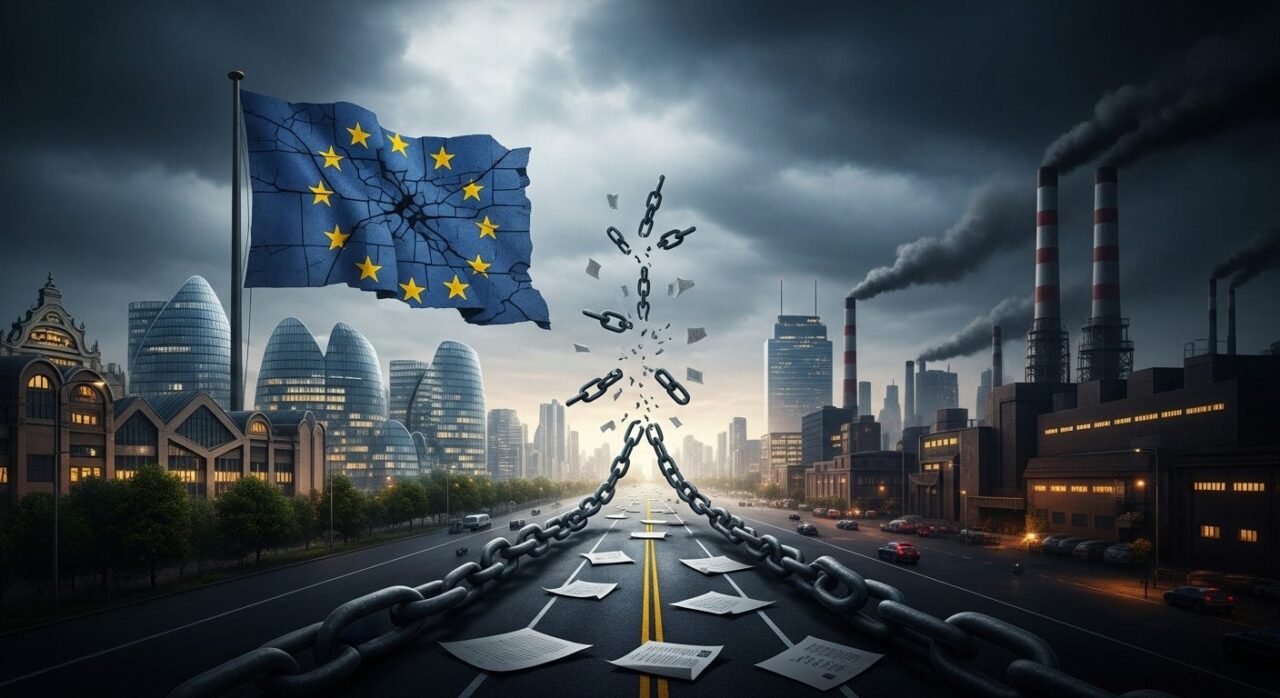
Germany’s economy minister has just broken one of Berlin’s biggest taboos: she openly called the European Union a “regulatory brake” on German competitiveness – and did it from inside a mainstream government, not from the AfD sidelines. That does not mean Germany is getting ready to dismantle the EU tomorrow morning. But it does mean something important has shifted.
When the country that has benefited most from European integration starts publicly asking whether Brussels is still an engine or now a drag, the question “what if this cannot be fixed?” stops being fringe speculation and becomes a live strategic scenario.
Context: How Germany and the EU Became Inseparable
For decades, the EU has been the solution to the “German question”: a country economically too large for its neighbours to ignore and politically too dangerous to leave entirely unconstrained. Integration turned Germany’s industrial might into the core of a shared project rather than the core of a new empire.
In this current political cycle, Germany is stuck in a prolonged stagnation: several years of zero or near-zero growth, high energy prices, and recurring warnings about de-industrialisation. Major institutes and the IMF see minimal growth ahead, while Germany risks its third straight year of flat or negative output. (Atlantik-Brücke e.V.)
Into this mess stepped Friedrich Merz as chancellor and Katharina Reiche as Federal Minister for Economic Affairs and Energy in May 2025. (bundesregierung.de) Their mandate in practice: stop the slide before Europe’s industrial anchor drags the rest of the continent down with it.
For years, Berlin’s official line was simple: Germany has problems, the EU has problems, but “more Europe” is always part of the answer. The unspoken rule was that you could complain about bureaucracy in Berlin or Brussels, but you did not question the EU’s role as Germany’s natural, almost sacred framework.
That is the rule Reiche just violated.
Evidence: Reiche’s Break with the Script
In recent remarks on Germany’s competitiveness, Reiche argued that German companies are being suffocated by over-regulation, high energy costs and a welfare state that weighs heavily on labour. She called for “fundamental reforms” not only in Berlin but also at EU level, insisting that the Union must again become a driver of competition instead of being perceived as a regulatory brake. (fakti.bg)
A few key points buried in that choice of words:
- She explicitly links Germany’s structural crisis to the way EU rules are designed and implemented, not just to domestic policy.
- She frames Brussels not as a neutral playing field but as part of the problem for German industry.
- She calls for deep reform, signalling that incremental tweaks inside existing rulebooks are no longer seen as enough.
At the same time, the broader debate around Europe is hardening. Think tanks and liberal economists warn that the EU’s bureaucracy and tax burden are strangling growth and competitiveness, demanding “radical re-thinking” instead of yet more layers of rules. (ecipe.org)
Further out on the political spectrum, the German AfD and allied forces across Europe already have clear blueprints for dismantling the EU in its current form and turning it into a loose confederation of nation-states with sharply reduced common powers. (euractiv.com) Elsewhere, detailed far-right policy papers sketch out how to cut the Commission down to a mere administrative secretariat and strip EU courts and parliament of real power. (EL PAÍS English)
Reiche is not endorsing those plans. But she is taking one crucial step in their direction: publicly accepting the premise that the EU, as currently built, can be an obstacle to German interests.
Analysis: The Taboo That Just Cracked
Why is this such a big deal?
Because once you say out loud that the EU is a structural drag on your economy, three uncomfortable questions immediately follow:
- Can the EU actually be reformed fast enough?
Brussels’ legislative machine is slow, consensus-driven and deeply entangled in interest groups. You don’t redesign a single market, an energy market and a regulatory state in two or three years. - What if France and smaller member states don’t share Germany’s priorities?
For Paris, more industrial policy and more EU-level intervention often are the solution. For many smaller countries, the Commission is a shield against being crushed between Berlin and Paris. They may resist any reform that looks like “less Brussels, more Germany”. - If reform stalls, what then?
At that point the question stops being “how do we fix the EU?” and gradually becomes “how do we protect our national economy from a malfunctioning EU?”
This is where the Soviet comparison from the Frontiernieuws piece actually makes sense – not as a prediction of imminent collapse, but as a warning about logic. Once the ruling class of any system admits that its core ideology (communism then, “ever closer union” now) is part of the problem, the internal coherence of that system begins to unravel.
We’re not there yet. But Reiche’s statement tells us something important:
- Berlin has moved from denial (“problems yes, but the EU is sacred”)
- to ambiguity (“the EU is part of the solution and part of the problem”)
The next phase would be conditional support: “if we cannot fix this, we must consider alternatives.” That’s when talk of dismantling or radically refounding the EU moves from fringe manifestos into internal strategy papers.
Implications: Scenarios If Germany Loses Faith
If Germany’s mainstream elite seriously starts to see the EU as an unreformable brake, a few realistic scenarios open up:
- Brutal Internal Reform Push
Berlin and its allies use their weight to force through aggressive deregulation, industrial support and energy reforms at EU level, even at the cost of major political conflict. This keeps the EU intact but turns it into something much more brutally pro-industry and less “values-driven” than the current von der Leyen line. - Two-Speed or “Core Europe” 2.0
A core of states around Germany quietly builds parallel structures – industrial funds, defence integration, energy alliances – leaving a more symbolic shell of the old EU in place. Legally it’s reform; in practice it’s a controlled partial disassembly. - Slow Erosion and Informal Opt-Outs
Instead of a big bang, Germany and others quietly under-implement, delay or “reinterpret” EU rules that hurt them, while improvising national measures to protect key industries. Officially the EU survives; in reality it becomes a patchwork. - Open Break – The Low-Probability Shock
The nightmare for Brussels but still low-probability: a future German government concludes that dismantling or exiting the current EU architecture is the lesser evil compared to permanent stagnation. Politically, this would be comparable to the breakup of the Soviet bloc – messy, dangerous and impossible to fully control.
What makes all of this more than academic speculation is precisely that Germany’s economy is now the weak link, not just its politics. A prolonged de-industrialisation of Europe’s central power is incompatible with the survival of the EU in its current form. Something will have to give: either the rules, or the expectations, or the institutions themselves. (Atlantik-Brücke e.V.)
Verdict: Not Dismantling the EU Yet – But Thinking the Unthinkable
Germany is not “preparing to dismantle the European Union” today. There is no official plan, no referendum date, no cabinet paper on how to unwind 70 years of integration.
But the real story here is deeper – and more dangerous for Brussels.
For the first time, a sitting German economy minister has adopted a core element of the Eurosceptic narrative: the idea that the EU has stopped being a motor for prosperity and has become an active brake on national competitiveness. (fakti.bg)
Once that thought is accepted in Berlin’s political and business elite, the Overton window shifts. If the EU cannot be repaired, the same logic that made it the answer to the German question can, over time, make its dismantling or radical refounding thinkable as a last-resort option.
That is where we are now: at the very beginning of a new discussion. Germany is still inside the EU tent – but for the first time in decades, people in Berlin are quietly checking where the exits are.
📚 Sources
- Fakti.bg – Germany Loses Competitiveness (English summary of Reiche’s remarks on EU as “regulatory brake” and call for fundamental reform) – https://fakti.bg/en/biznes/1010492-germany-loses-competitiveness (fakti.bg)
- Facebook repost of Reiche’s comments in multiple languages (ENG/EST/RUS), confirming the same key quotes – https://www.facebook.com/100006206509210/posts/4052384188311758 (Facebook)
- German Federal Government – official biography of Federal Minister for Economic Affairs and Energy Katharina Reiche – https://www.bundesregierung.de/breg-en/federal-cabinet/2343564-2343564 (bundesregierung.de)
- Financial Times – Can anything halt the decline of German industry? (on prolonged stagnation and industrial crisis) – https://www.ft.com/german-economy (Financial Times)
- Euractiv – German AfD wants to dismantle EU, turn into confederation of nations – https://www.euractiv.com/news/german-afd-wants-to-dismantle-eu-turn-into-confederation-of-nations (euractiv.com)
- El País (English) – The far right’s detailed plan to dismantle the EU – https://english.elpais.com/international/2025-06-14/the-great-reset-the-far-rights-detailed-plan-to-dismantle-the-eu.html (EL PAÍS English)