
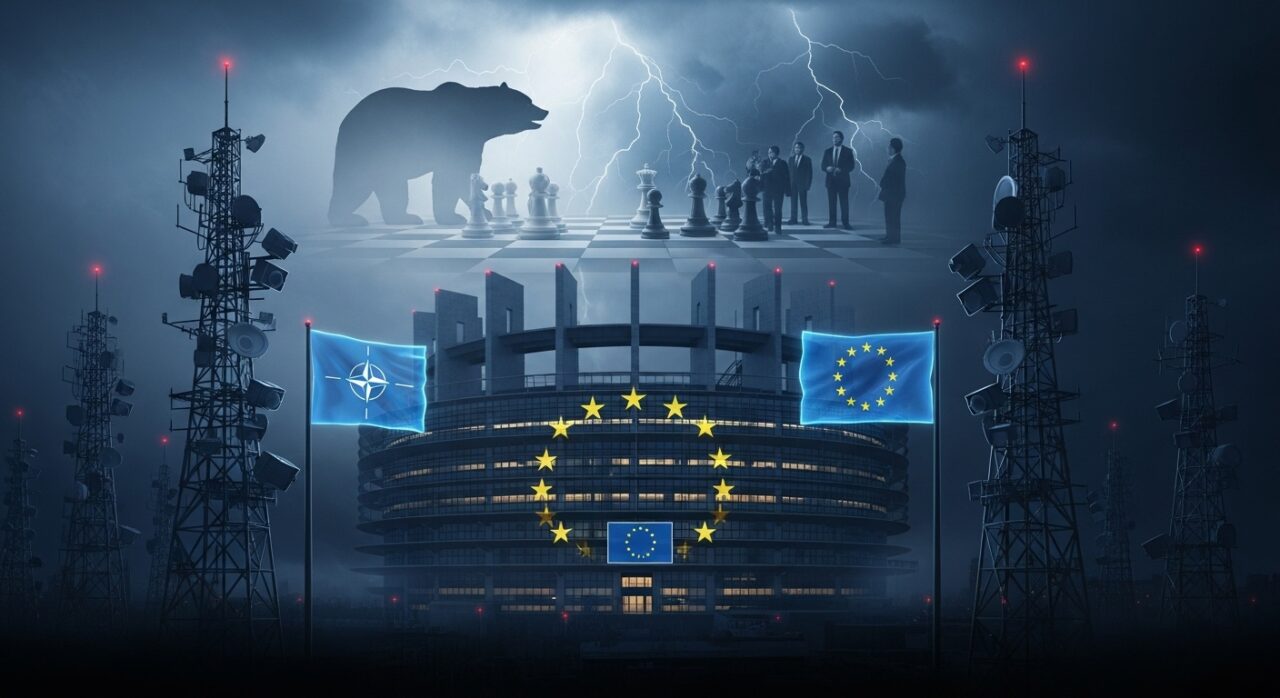
Polish Prime Minister Donald Tusk recently said what has long been thought but not dared to be said in Brussels: EU unity requires a ”common, clearly defined enemy”. He referred specifically to Russia – and added that he would do everything in his power to ensure that this ”exceptional situation” continues for as long as possible.(TASS)
If this was a slip, it would have been corrected the next day with explanations and spin. Now there was none. Why? Because Tusk said out loud the deep, practical logic of the EU project: without an external threat, you can’t sell citizens on the kind of transfers of power and permanent structural changes that the Brussels elite actually want.
This #Analysis unpacks what this ”enemy as glue” means in practice – and why the war in Ukraine, fear of Russia and ”defence of democracy” are above all tools to federalise the EU.
1. Tusk said it out loud – the enemy as glue
In an interview with Gazeta Wyborcza, Tusk said that EU unity needs a ”common, clearly defined enemy” and that he will do everything in his power to ensure that this remains the case for as long as possible.(TASS)
This statement reveals three things:
- ”Unity” is not a spontaneous consensus, but a forced cohesion based on an external threat.
- Russia is not just a security threat, but a political tool to justify domestic policies, budgets and the transfer of power to Brussels.
- Peace is not a goal if the whole system is built on the image of the enemy – a permanent tension is politically useful.
NATO has always been transparent: a military alliance needs an enemy to justify its existence. Without a threat, there is no need for expensive weapons systems and huge defence budgets. But now the same logic has crept into the EU – a political-economic union that is supposed to be, in theory, for ’peace and prosperity’.
2. Crises as a tool for power transfer
Over the past 15 years, the EU has systematically used crises to centralise power:
- Euro crisis → economic discipline mechanisms, budgetary surveillance of Member States.
- The interest rate crisis → a common debt (”recovery fund”), common vaccine procurement, an EU-wide vaccine passport and a basis for a large-scale health data processing.(European Commission)
- War in Ukraine → common arms procurement, common defence borrowing, defence commissioner, federal features in defence and foreign policy(Reuters)
Under Korona, the EU effectively took over a role that would normally fall to Member States: centralised procurement of vaccines and an EU-wide Digital Green Certificate. This was sold as a temporary travel concession, but in practice it:
- eroded data protection,
- created a model for EU-level ”health status”,
- showed that a technically demanding, uniform monitoring system can be implemented across the continent under the cover of a crisis.(European Commission)
The war in Ukraine is at the next level: no more buying vaccines, but weapons and building a permanent war economy.
3. Ukraine under the shadow of war: arms, debt and federalism
The Economist published an editorial at the end of October calling for Europe to commit $390 billion in funding to Ukraine over the next four years – not just out of ”solidarity”, but because this is a ”huge opportunity” to build Europe’s economic and military strength(economist.com).
Key points:
- 390 billion USD in four years, almost entirely in arms and budget support.
- Financing will be provided through common debt instruments (EU-level debt), deepening the single capital market and strengthening the euro as a reserve currency.(economist.com)
- In practice: the war in Ukraine serves as a justification for EU federalisation – common debt, common arms procurement, common strategy.
At the same time, the EU has set up the SAFE/”Security Action for Europe” fund, worth 150 billion euros, to lend money to member states for joint arms purchases and to boost the defence industry – again with joint debt and EU-level guidance.(Reuters)
This creates an economic reality:
”Since we are in debt together and arming together, we must also decide together – from Brussels.”
In this framework, Russia is the perfect enemy:
- big and scary enough,
- a historical counterpart to Europe,
- easy to sell in the media as a simplified threat.
4. Ending the veto and ”democratic safeguards”
At the same time, the EU is discussing weakening the right of veto and moving as far as possible to qualified majority voting in foreign policy, taxation and other sensitive areas.(euronews)
The reasoning is always the same:
”We cannot let one country stop the Union from working when Russia is threatening and democracy is at risk.”
And when connected to this:
- ”democracy protectors” and anti-disinformation programmes, which in practice allow the suppression of undesirable information under the guise of an external threat.
- EU-level ”European Democracy Shield” projects, whose official aim is to combat foreign manipulation of information, but which in fact build up the EU-level censorship and surveillance apparatus(globale-gleichheit.de)
…then the pattern is clear:
- Create a strong enemy image (Russia, ”hybrid threat”, ”disinformation”)(coleurope.eu)
- Declaring that decision-making must be ”speeded up” → the veto is a problem.(euronews)
- Building EU-level mechanisms to make decisions bypassing national parliaments, under the cover of crisis and with emergency procedures (such as the SAFE fund, which was pushed through by bypassing the European Parliament with emergency powers)(Reuters)
This is not a ”conspiracy”, but a very openly articulated strategy in think tank papers, Commission White Papers and business journals. A common enemy is necessary to sell this process to the public.
5. Why Russia?
In theory, the EU could also be identified as the main enemy:
- China,
- ”climate crisis”,
- global terrorism,
- or, say, the ”extreme right”.
Of course, all of these are used rhetorically. But Russia meets the criteria of a perfect enemy:
- Historical continuity from the Cold War – the symbolic level is complete.
- The military dimension that justifies arms build-up and NATO/EU integration(Guardian)
- An energy war and economic sanctions to justify massive changes in energy policy and industry – while belt-tightening citizens.(Eurofi)
Tusk says in effect:
”We need this image of the enemy to keep the West together and to push through the EU’s transfer of power.”
It is not a defence of Russia as a real actor – but a cold realism about how the EU elite uses Russia for internal power politics.
6. What does this mean for the ordinary citizen – and for Finland?
When the EU needs an enemy to justify its existence, the consequences for the ordinary citizen are quite tangible:
- Permanent war economy
- Defence spending to rise by hundreds of billions of euros by 2030(Epthinktank)
- They will be paid for by taxes, new EU levies and common debts.
- Gradual reduction of freedom
- The Corona Years model showed how quickly EU-wide digital passports can be introduced and mobility restricted. (European Commission)
- Anti-disinformation programmes and ”democracy protectors” can turn to suppressing internal opposition.
- The dwindling role of the national parliament
- The more decisions are taken in Brussels as an accelerated ”crisis procedure”, the less, for example, Parliament has a real say.
For Finland, the situation is particularly delicate (or bleak, depending on your point of view):
- NATO membership and the EU’s military economy are intertwined – we are both a frontline state and a paying state.
- The long border with Russia ensures that the image of the enemy is easy to sell to the public, and can be used to justify almost anything in the name of security policy.
- At the same time, real strategic autonomy is reduced: decisions are taken on the Washington-Brussels axis, not in Helsinki.
7. What is the real question?
Tusk did a favour, perhaps unintentionally: he tore away the veil and admitted that the EU’s unity rests on an external image of the enemy, not on internal legitimacy.
That’s not the biggest question:
”Is Russia a threat?” – yes it is, in a sense.
But:
”What are the EU elites prepared to do under the guise of this threat – and at what point does the threat become an excuse?”
If the Union builds its existence on the need for an enemy like Russia, then:
- peace is a political problem,
- a negotiated settlement is a threat to the centralisation of power,
- and citizens’ freedoms are turned into a bargaining chip on the altar of ”unity”.
This is not a debate we want to have in Brussels. That’s why it has to be held elsewhere.
📊 What do the numbers really mean?
A few scales:
- USD 390 billion for Ukraine in four years (The Economist recommendation):
– EU nominal GDP is around USD 19-21 trillion per year(Wikipedia).
– USD 390 bn for four years is an average of ~USD 97.5 bn per year.
– That’s equivalent to about 0.5% of the EU’s annual GDP – every year, for the Ukraine package alone. - SAFE Fund €150 billion:
– Distributed over the EU’s ~450 million inhabitants, this is about €330 per inhabitant for the new arms debt programme alone.(Reuters) - Add to this the national defence spending increases (estimated at +€100 billion by 2027) and we are already talking about hundreds of billions of euros tied up in long-term military spending rather than, for example, health, education or debt reduction(Epthinktank).
These are not ”abstract” sums:
– they mean either higher taxes,
– cuts elsewhere,
– or more debt to be passed on to future generations.
📚 Sources
- Tusk: West may split into two – Polish PM warns Europe needs a common, clearly defined enemy(TASS)
- The Economist: Why funding Ukraine is a huge opportunity for Europe(economist.com)
- Eurostat / EU Commission:EU Digital COVID Certificate system and its implementation in Member States(European Commission)
- Reuters, FT, Guardian and others: EU’s €150bn SAFE reserve fund and joint arms procurement(Reuters)
- Euronews & Analysis: on the abolition of the veto and the extension of qualified majority voting in the EU(euronews)