

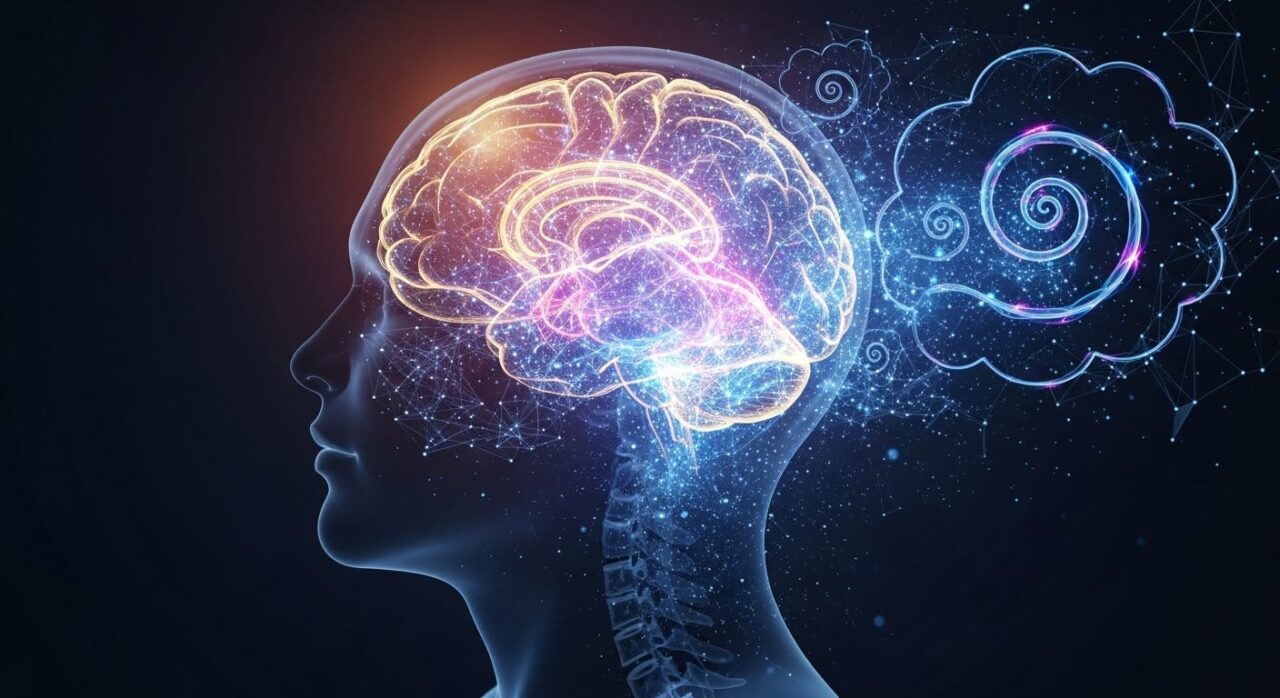
In a quiet lab at Columbia University, researchers have found what may be the brain’s earliest warning sign of a mental downward spiral. The discovery — a fleeting neural signal called the “pre-self pattern” — appears seconds before the mind turns inward and begins the type of repetitive self-focused thinking linked to depression and anxiety.
The study, published in the Journal of Neuroscience, moves science a step closer to explaining why some people get trapped in cycles of rumination while others can let go. As mental-health challenges rise worldwide, understanding this split between healthy self-reflection and destructive overthinking could reshape how clinicians detect and treat mood disorders.
Mapping the pathway to self-focus
Led by neuroscientists Meghan L. Meyer and Danika Geisler, the Columbia team used fMRI scans on 32 participants during rest. Within the brain’s default mode network — the interconnected system active when attention drifts from the outside world — they identified a distinct activity configuration that consistently appeared right before a shift into self-referential thought.
Further analysis of data from the Human Connectome Project revealed that people prone to internalizing emotions — a key risk factor for depression — slipped into this pattern more frequently. In short, their brains seemed “primed” to turn inward, even during neutral moments.
When looking inward turns toxic
Not all self-focus is harmful. Adaptive reflection helps people learn from experience and process emotions. But maladaptive self-focus, or rumination, turns that same process against us — looping endlessly over perceived mistakes and negative memories.
Neuropsychologist Amy Serin calls this feedback loop a “doom loop”: repeated negative thinking strengthens neural connections associated with distress until the pattern becomes automatic. The brain regions most involved — the anterior cingulate cortex (emotion regulation) and posterior cingulate cortex (memory integration) — reinforce one another in depression, making pessimism feel inevitable.
Promise and limits of prediction
Could identifying the pre-self pattern make early detection of mental illness possible? The potential is enticing, but experts caution against overselling it. Brain activity alone cannot yet predict who will develop depression or anxiety — genetics, trauma, and social context still matter profoundly.
Nevertheless, mapping the sequence that leads from idle rest to self-critical rumination helps clinicians see how negative thought loops take shape in real time. It also highlights where therapy and mindfulness might interrupt them before they become entrenched.
Breaking the cycle
Evidence-based therapies already offer ways to disarm these loops. Cognitive behavioral therapy (CBT) uses tools like the downward-arrow technique to uncover the core beliefs — “I’m not good enough,” “I’ll always fail” — that fuel rumination. Once surfaced, they can be challenged and replaced.
Simple, actionable steps include:
- Keeping a thought record to track recurring mental themes.
- Practicing self-compassionate language in daily inner dialogue.
- Building social support networks that provide external feedback and perspective.
Studies consistently show that supportive relationships counteract internal negativity more effectively than any single medical intervention.
Toward proactive mental care
The “pre-self pattern” discovery represents more than a scientific curiosity. It hints at a future where mental-health care could become proactive — identifying neural vulnerability before symptoms explode into full disorder. Yet even as brain science advances, the old truths remain: empathy, connection, and active self-awareness still matter most.
By bridging brain mapping with behavioral wisdom, researchers hope to turn understanding into prevention — breaking the doom loop not after it forms, but before the first turn inward begins.
📚 Sources
- The Epoch Times: “Breaking the Doom Loop: Scientists identify brain pattern preceding negative thought spirals” (2025)
- Journal of Neuroscience – Original research article on “pre-self pattern” brain activity
- Mayo Clinic: Overview of cognitive behavioral therapy
- Johns Hopkins Medicine: Rumination and depression risk factors