

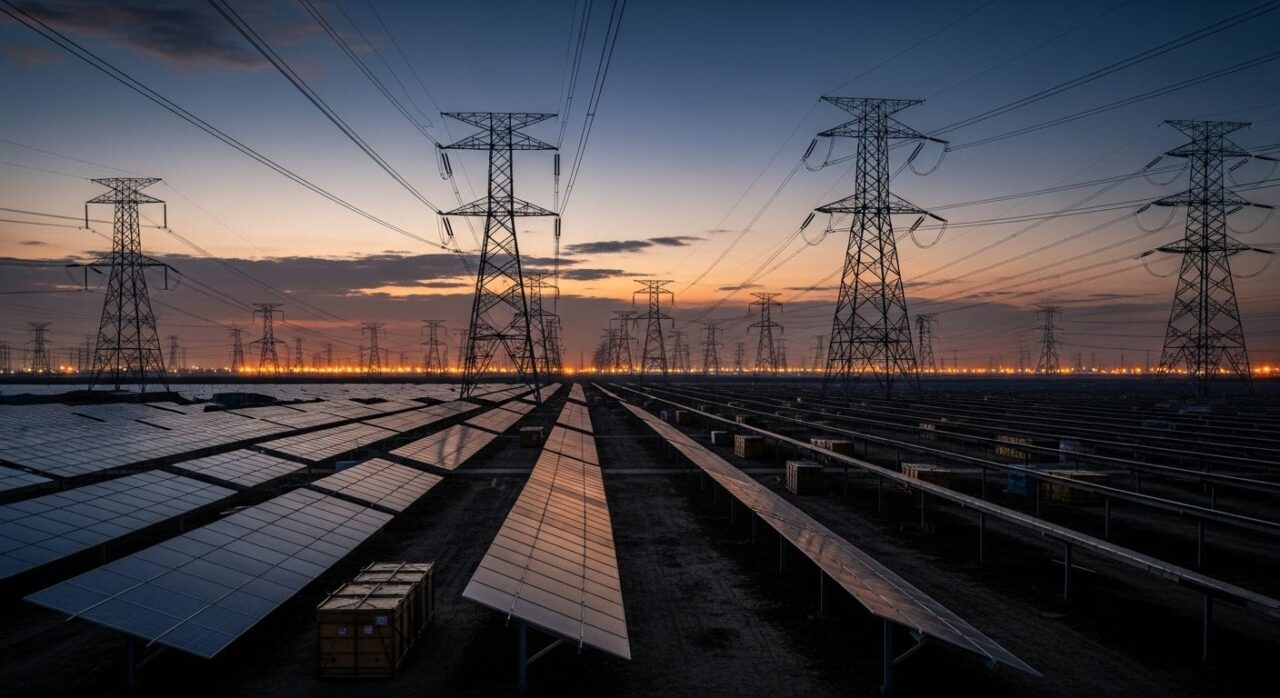
The world’s most populous nation has just delivered a sobering verdict on the economics of the energy transition. India is shelving up to 20 percent of its planned “green electricity capacity” because, quite simply, no one wants to buy the power without subsidies.
According to Bloomberg, more than 42 gigawatts of renewable projects are now on hold — roughly one-fifth of the total pipeline. State-owned utilities are drowning in debt, the national grid is stretched to its limits, and the public wants electricity that flows reliably, not intermittently.
Subsidy addiction meets grid reality
For years, India’s renewable expansion relied on feed-in tariffs and state-backed guarantees that masked true market costs. With those guarantees fading, the illusion of profitability has collapsed. Developers that once touted cheap solar and wind power now face the hard arithmetic of transmission fees, unstable supply, and the absence of buyers.
Beginning this quarter, new projects must pay 25 percent of their own transmission costs — a small policy change that has already frozen large swaths of investment. Without someone else footing the bill, the “green revolution” looks less like innovation and more like dependence dressed up as virtue.
A fragile grid, a hungry nation
India’s electricity demand is soaring. Industrialization and urban growth have pushed power consumption to record highs, while transmission networks remain fragile and unevenly modernized. In such conditions, adding vast amounts of weather-dependent generation amplifies instability. Even Germany — with a much denser, more advanced grid — has struggled to balance intermittent renewables. Expecting India to do so at scale, with far less infrastructure, borders on magical thinking.
Economic realism over ideology
Officials in New Delhi have framed the cancellations as removing “non-viable” projects. In practice, it’s a survival move: pull the plug before the entire subsidy-driven structure collapses. The policy marks a rare case of energy realism in global climate politics — recognizing that grid stability and affordability matter more than ideological targets.
Meanwhile, in Europe, governments continue to double down on the same model: pouring billions into wind and solar capacity while backfilling with imported gas and coal whenever the weather refuses to cooperate.
India’s message is blunt: energy transitions that ignore economics will fail. And when even a nation desperate for more power refuses to buy green electricity without subsidies, the global “clean-tech” narrative starts to look less like progress — and more like a bubble beginning to burst.
📚 Sources
- Report24: No buyers – India scraps “green electricity” projects (5 Nov 2025)
- Bloomberg Energy: India Shelves 42 GW of Renewable Projects Amid Lack of Buyers (2025)