
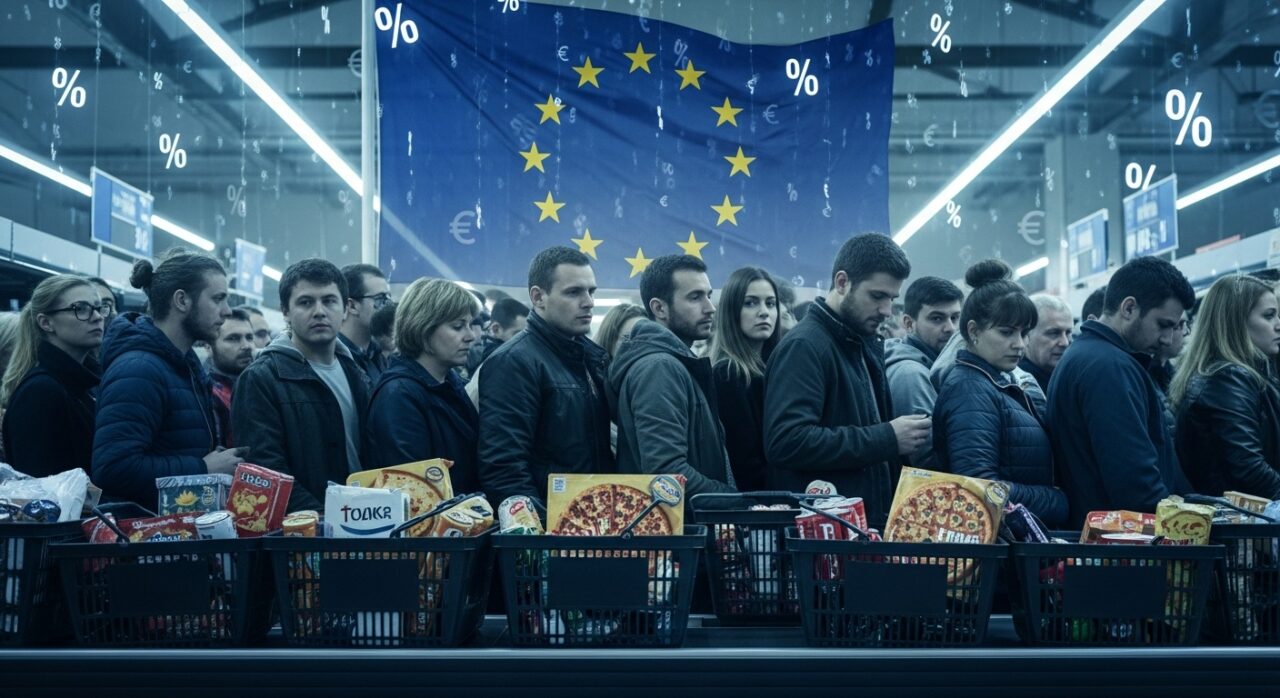
The EU’s recent draft cardiovascular health programme is not just a campaign or a recommendation. It brings to the table a new EU-level tax: on heavily processed foods and sweet alcoholic beverages classified as ”unhealthy” – from as early as 2026(Brussels Signal).
Context: heart health as a tax excuse
The Commission’s working title is the EU Cardiovascular Health Plan – a Union-wide cardiovascular health action plan due to be adopted in mid-December.(Euractiv)
According to the drafts, one of the most politically sensitive parts of the plan is an EU-wide tax on ”ultra-processed” foods and so-called alcopops – heavily sweetened alcoholic beverages consumed by young people in particular.(Brussels Signal)
In practice, the targets are:
- crisps and snacks
- convenience food
- sweets and chocolate
- soft drinks and energy drinks
- sweet ”liqueurs” and alcopops
The Commission has not provided a final, precise definition of what exactly constitutes ”unhealthy” or ”ultra-processed”. The draft talks about HFSS (high fat, sugar, salt) criteria and leaves a lot of room for interpretation for future implementing rules.(Euractiv)
Two hard figures are used as background: cardiovascular disease causes around 1.7 million deaths per year in the EU and a total annual cost (health care, loss of productivity, social costs) of more than €280 billion(European Commission).
From these figures, a political message is derived: ’Heart disease costs everyone money, therefore we have the right to control everyone’s diet through taxation.’
Evidence: what is the EU really up to?
Brussels Signal and Euractiv have obtained the Commission’s draft. According to the draft:(Brussels Signal)
- The aim is an EU-wide framework for taxing unhealthy food by 2026.
- The Commission wants to create a network of ”competent authorities” to coordinate the taxation of ”unhealthy food” between Member States.
- At the same time, a database of all existing health taxes in the Member States will be built – as a model and a basis for comparison.
- The draft talks of a ”small but symbolic” EU-level tax that would push member states into line.(Brussels Signal)
So this is not just a ”recommendation for a healthier life”. It is a harmonisation of tax policy at EU level – in effect a first step towards the Union’s own ’fat tax and limousine tax infrastructure’, which can be tightened up later.
Meanwhile, industry has already reacted. Food and drink industry lobby groups warn that:(just-drinks.com)
- costs are passed on directly to consumer prices
- the tax would be regressive – it would hit low-income earners hardest
- cross-border trade would be distorted if certain product groups were labelled ”sinful” at EU level
In other words: the political battle is not health versus ”bad industry”, but the right to tax at EU level versus the economic and food policies of the Member States.
Analysis: health rhetoric, power and money
It is absolutely true that cardiovascular diseases are the deadliest group of diseases in Europe and that they cost a huge amount of money and lives. There is solid data on this and in that sense the Commission’s problem statement holds.(European Commission)
But how the problem is used as a political tool is a different matter.
A few key observations:
- The tax solution is politically easy, but lazy in substance.
Health is the sum of many things: exercise, sleep, stress, tobacco, alcohol, medication, working conditions, socio-economic status. Yet the Commission picks the familiar single variable – fat/sugar/salt in food – and offers the same familiar tool: a tax. - The target group is the same as always: the low-income consumer.
There are years of experience with health taxes – soda taxes, for example – and the research evidence is mixed: consumption may be slightly diverted, but the disadvantages are concentrated on the poorest, who have the least room to manoeuvre against price rises.(lexology.com) - The EU is using the health argument to extend its own competence in taxation.
DG TAXUD’s recent report on EU-wide excise duties on HFSS products does just that: it not only assesses the health impacts, but argues why taxes should be brought to the EU level, and not just left to Member States(lexology.com). - The confidence base is thin after years of high interest rates.
When the same institutions that only yesterday were marching vaccine and passport policies in the name of ”public health” now come to tell us what we can eat and drink, many are already fed up. The small but real increase in the risk of myocarditis in certain groups associated with vaccines is well documented – and long silenced.(PMC)
This makes the new ”heart health tax project” more politically dubious than perhaps Brussels realises.
Summary: Health is real, but the solution is political. It’s not just about the hearts of citizens, but about EU-level powers and the extension of taxation to new areas.
Consequences: what does the fat tax mean in practice?
If the draft goes ahead as planned and the EU framework for the tax is locked in by 2026:
- Prices will rise – first symbolically, then gradually more. Not once have we seen a ”temporary” birth tax that was later abolished.
- Product groups are politically labelled. Declaring certain foods ”unhealthy” at EU level gives a mandate to tighten regulation (advertising bans, packaging, warning labels, prescription requirements).
- Member States’ room for manoeuvre will be reduced. With the basic framework at EU level, national policy becomes in practice just a fine-tuning of the tax rate.
- The transfer of income from the consumer to the state is accelerating. Money is collected in the name of ”health”, but there is no guarantee that it will actually be spent on prevention or treatment – experience with taxes on fuel and tobacco, for example, does not give cause for optimism.
At the same time, something else is happening in the background: the wave against ultra-processed food is gaining momentum globally. Studies and media campaigns are branding the UPF diet as the new ”big threat” – and politicians are using this to push for new tax bases and regulation.(France 24)
Objection: are there alternatives?
There is no need to deny the health risks to oppose the EU’s fat tax guidelines. There are alternatives:
- Genuinely neutral health incentives: VAT reductions for fresh vegetables and quality protein, instead of just penalising ”bad” food.
- A transparent research base: all the evidence on tax decisions – including critical assessments – would be opened up to public debate, not just summarised policy papers from the Commission.
- National pilot first: if you want to see if the fat tax works, you can run a limited, time-limited pilot in a single country or region and assess the results before an EU-wide model.
But these do not offer the same thing the EU seems to be looking for: a new permanent, broadly scalable tax base that can be sold to voters as ”heart health” and ”another big crisis besides climate”.
Verdict: one direction – more taxes, less choice
The fat tax is not an isolated detail, but a continuum:
- first CO₂ taxes and emissions trading
- then blowing up energy prices in the name of a ”green transition”
- now heart health and ultra-processed foods
The formula is the same every time: the problem is real, but the solution is consistently the same – more taxes, more EU-level powers, more top-down control.
The adult citizen becomes, by default, a managed risk, not an autonomous individual. Brussels does not trust people to decide for themselves what they eat and drink – so they are ’guided’ by taxation and regulation towards the ’right’ choices.
Once such a tax is introduced, it never goes away. It only grows, expands and deepens. The EU knows only one direction: more government, more taxes, more rules – and less freedom to choose what to put on your own plate.
📊 What do the numbers really mean?
- The€280-282 billion per year cost of cardiovascular disease in the EU is around €630 per EU citizen per year – equivalent to one or two monthly electricity bills per person in many countries.(escardio.org)
- 1.7 million deaths a year means an average of nearly 4 700 deaths every day – more than the population of an entire medium-sized Finnish city would lose in a calendar year.(European Commission)
These figures are politically effective, and they reflect the real problem. But on their own, they tell us nothing about whether an EU-level fat tax is an effective or fair way to tackle the issue – that is a separate, political choice.(lexology.com)
📚 Sources
- Brussels Signal: EU sets sights on ’fat tax’ to boost health (20.11.2025) – brusselssignal.eu(Brussels Signal)
- Euractiv: EU wants to tax unhealthy food and alcopops by 2026 under heart health plan – euractiv.com(Euractiv)
- European Commission / DG SANTE: EU Cardiovascular Health Plan – call for evidence – ec.europa.eu(European Commission)
- ESC & Oxford University: Burden of cardiovascular disease and €282bn annual cost – escardio.org(escardio.org)
- Just-Drinks / Industry reactions: Industry hits out at report of EU mulling food, alcopops health tax – just-drinks.com(just-drinks.com)
- France24: Ultra-processed foods a rising threat to health – france24.com(France 24)