

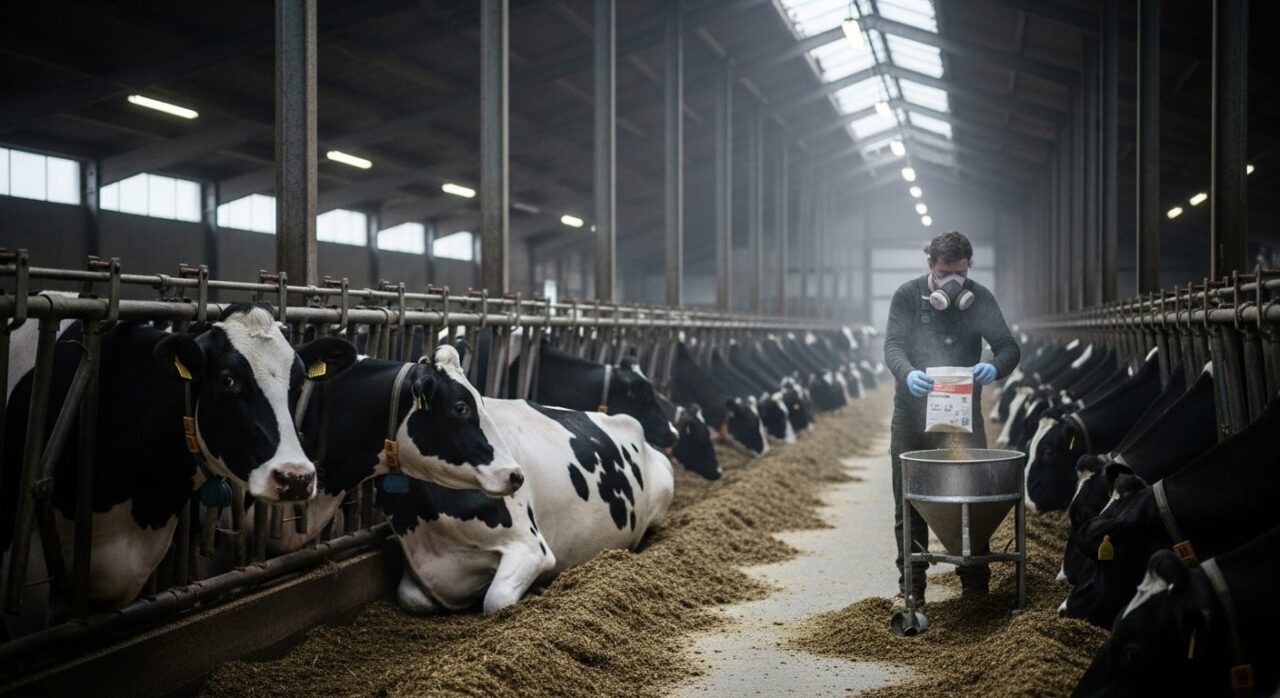
As Denmark rolled out a mandatory methane-cutting regime this autumn, the only approved route for most conventional dairy farms ran straight through a synthetic feed additive known as Bovaer. Within weeks, farmer hotlines lit up: listless cows, collapsing in stalls, milk yields sliding, some animals culled. Regulators insist the product is safe “when used correctly.” The gap between policy promise and barn-floor reality has never looked wider.
The policy that cornered farmers
Denmark’s climate rules for conventional dairy herds flipped from theory to practice in 2025. By law, producers must reduce enteric methane via feed management—either by raising feed fat or by dosing a methane-inhibiting additive. As of 2025, Bovaer (3-NOP) is the only additive approved for that purpose in Denmark, with precise dosing guidance and subsidies to offset cost. In effect, that made Bovaer the default path for most of the country’s ~2,000 herds. (foedevarestyrelsen.dk)
Compliance isn’t vague. Advisory notices circulated to farmers spelled out that 2025 use must cover at least 80 days (e.g., start by early October to finish by year-end), at specified mg/kg dry-matter rates—requirements that pushed many producers to begin dosing right after 1 October. (Kvægrådgivning Danmark)
Then the phones started ringing
By late October and into early November, Denmark’s farmer association lines were inundated. Reports described cows going off feed, rumen function stalling, yields falling—and in some barns, animals collapsing and requiring euthanasia. The chair of the National Association of Danish Milk Producers, Kjartan Poulsen, told national media they were fielding distress calls from across the country and launched an internal inquiry. The stories reached Parliament, where a formal question asked whether a legal requirement could be squared with animal-welfare law “when cows have been seen collapsing and dying.” (Presse-fotos.dk)
Denmark’s leading animal-welfare NGO, Dyrenes Beskyttelse, publicly urged the government to pause the legal requirement, citing mounting reports of poor cow welfare since October and noting that the additive’s approval emphasized climate and food-safety endpoints but not comprehensive, independent animal-welfare effects. Aarhus University’s welfare project on Bovaer isn’t due to report until 2028. (dyrenesbeskyttelse.dk)
It wasn’t just advocacy groups. Danish ag trade outlets carried editorials calling for a suspension until the situation is clarified, while industry reporting documented vets noting rumen atony, sudden deaths and reduced cud chewing “in some animals” under the mandated program. (effektivtlandbrug.landbrugnet.dk)
Amid the backlash, the Danish Food Agency (Fødevarestyrelsen) issued new guidance: entire herds can be exempted from Bovaer dosing when metabolic or feeding-related problems are suspected to be linked to the additive. That is a remarkable regulatory pivot just weeks into rollout. (landbrugsinfo.dk)
Regulators say “safe when used correctly.” Farmers say “that’s not what we’re seeing.”
Official messaging has emphasized that Bovaer is EU-authorized and that scientific reviews found no consumer-safety concerns and no adverse effects on cows under the proposed conditions of use. Denmark’s Food Agency reiterated in December 2024 that there was “no reason for concern,” and points to EFSA’s dossier and the EU authorization. Those assessments are real—and they matter. (foedevarestyrelsen.dk)
But two truths can coexist:
- Paper safety: EFSA’s FEEDAP panel concluded Bovaer reduces methane and is of no concern for consumers or the environment at approved doses. It also flagged that 3-NOP is irritant, harmful if inhaled, and that genotoxicity isn’t fully elucidated—hence strict handling rules for workers. That’s why the Safety Data Sheets instruct masks, gloves, and eye protection, and warn about dust-air explosion risks. (European Food Safety Authority)
- Field signals: A first-of-its-kind, near-nationwide rollout concentrates risk. If mixing protocols slip, if ration formulation or dry-matter assumptions are off, if barn-level variability spikes, welfare effects can surface before surveillance catches up. Denmark’s rapid exemption guidance tacitly acknowledges that reality. (Maskinbladet)
What Bovaer actually does to the cow
Bovaer’s active 3-nitrooxypropanol works as an enzyme inhibitor in the rumen, dialing down methyl-coenzyme M reductase in methanogens—microbes that convert hydrogen and CO₂ to methane. Less methane is emitted; peer-reviewed meta-analyses show ~30–33% reductions on average. That’s the intended climate lever. But the rumen is an ecosystem. Suppressing one microbial pathway at scale can ripple through fermentation dynamics, feed intake, and animal performance—especially if dosing or ration design are imperfect. (Journal of Dairy Science)
EFSA’s and others’ controlled studies did not find zootechnical performance penalties at the tested doses. Yet Denmark’s barn-floor experience suggests implementation risk—the classic difference between trials and real-world deployment under time pressure and legal compulsion. (FEFAC)
A governance failure dressed as climate policy
Call the Danish rollout what it is: a mass intervention into a biological system that feeds people. Policy makers fast-tracked a single tool into near-monopoly status (because it was the only approved additive), then bound compliance to the calendar. The result? Farmers became the quality-control loop.
The consequences were predictable:
- Concentrated single-point dependence. With only one EU-approved additive available, the “choice” was theoretical. In practice, Bovaer became de facto compulsory in conventional herds—especially when fat-supplement strategies weren’t already in place. (foedevarestyrelsen.dk)
- Rushed barns, imperfect mixing. Regulators now emphasize correct blending and uniform distribution to avoid overdosing—an implicit admission that implementation details can make or break outcomes. (Maskinbladet)
- After-the-fact relief valves. Only after complaints surged did authorities clarify that whole herds could be exempted, not just individual cows, if welfare issues emerged. That’s emergency governance, not resilient design. (landbrugsinfo.dk)
This isn’t about “anti-science.” It’s about good science and consent.
If you want public buy-in, you cannot wave away barn-floor evidence as “misinformation.” In the UK last year, an Arla pilot with Bovaer triggered milk-boycott videos and a tabloid-social firestorm. At the time, mainstream outlets stressed the approvals and debunked wild claims (cancer, fertility scares). But the lesson from Britain wasn’t that all criticism is kooky; it was that transparency and humility are essential when tinkering with food systems. (Reuters)
Denmark just supplied the harder lesson: when you mandate a biochemical intervention at national scale, you own every adverse event, every mixing error, and every dead cow. You also own the political fallout in neighboring countries (the UK included) trying to write 2030 methane mandates right now. (Volta Greentech)
What a sane path looks like
- Immediate pause on compulsion. Keep Bovaer optional, not de facto obligatory; maintain the newly announced herd-level exemptions while independent investigators document incidence, mechanisms and risk factors. (landbrugsinfo.dk)
- Independent farm-level audits. Randomized, barn-by-barn reviews of ration design, mixing uniformity, and health outcomes—published in full. Tie any continued subsidy to verified best practice.
- Animal-welfare endpoints first. Climate benefits without validated welfare safety are a false economy. Fund rapid studies that go beyond milk-tank analytics into behavioral metrics, rumen motility, subclinical acidosis, and reproductive outcomes.
- Real alternatives. Expand the fat-supplement route, prioritize pasture-based systems, and accelerate approval pathways for diverse methane-reduction tools (so one product isn’t a choke point). (foedevarestyrelsen.dk)
- Radical transparency. Publish a rolling adverse-event database—symptoms, dates, rations, mixing methods, brand batches—so the entire sector learns in real time.
- Respect informed refusal. Farmers are the stewards here. If the people who live in the barns say something’s wrong, treat that as signal, not noise.
Bottom line
Bovaer may yet prove a useful tool—when voluntary, properly mixed, and suited to the ration. That’s not what Denmark trialed this autumn. It trialed compulsion, and the barns answered back. Whether you view the cow as a sacred link in a natural cycle or a methane emitter to be engineered away, the ethics are the same: don’t run a biochemical mandate faster than your welfare science can follow.
Sources (neutral labels)
- Danish Food Agency (Fødevarestyrelsen): official pages on Bovaer, safety note, and the “feed-management” rule allowing either fat or additive. (foedevarestyrelsen.dk)
- Danish Dairy Board: explanation of the 2025 legal requirement and options; Bovaer as the only approved additive. (danishdairyboard.dk)
- Farmer compliance guidance: advisory detailing the 2025 “80-day” requirement and October start. (Kvægrådgivning Danmark)
- Parliamentary record: formal question to the Food & Agriculture Minister citing reports of collapsing and dead cows post-mandate. (ft.dk)
- Animal-welfare NGO statement: Dyrenes Beskyttelse calls to pause the legal requirement pending welfare assessment. (dyrenesbeskyttelse.dk)
- Trade/industry coverage: editorials and reports documenting symptoms and calls for suspension. (effektivtlandbrug.landbrugnet.dk)
- Exemption guidance: authorities clarify whole-herd exemptions when metabolic issues are suspected. (landbrugsinfo.dk)
- EFSA & EU law: scientific opinion and Commission Implementing Regulation authorizing 3-NOP. (European Food Safety Authority)
- Safety Data Sheets: PPE and handling hazards for 3-NOP/Bovaer 10. (sdsmanager.com)
- UK protest context: Arla pilot backlash and fact-checking coverage. (Reuters)