

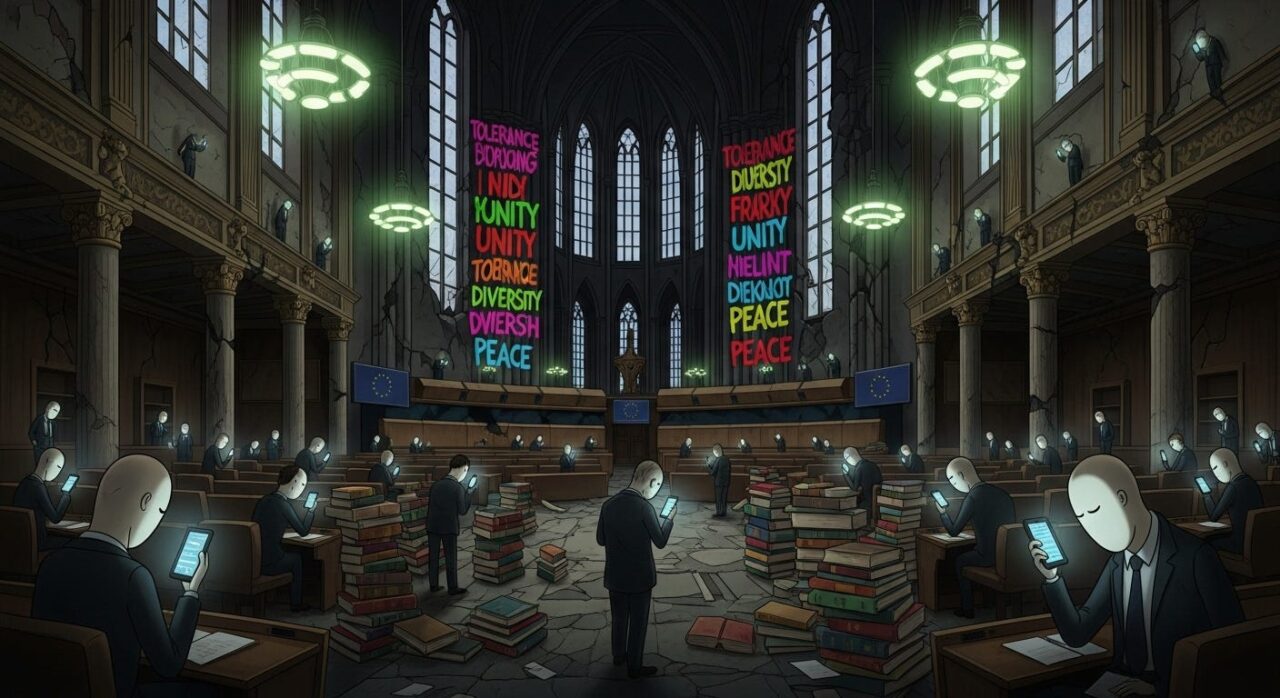
Idiocracy didn’t start with Mike Judge’s film, but the film gave it a name. In it, people are put into cryo-sleep and wake up 500 years later in a world where intelligence has vanished, advertising jargon is the official language, and the president is a former pro-wrestler.
Fiction, we thought. Then we took a look at the news.
When stupidity becomes a system
Real idiocracy doesn’t come from genes, but values. It appears when education becomes a ritual instead of learning how to think; when universities train more brand managers than logicians; when “critical thinking” is rebranded as extremism and a security risk.
It also grows from the West’s strange obsession with self-hatred. We’re the only civilization that treats itself as the default culprit for everything. In every story there are mistakes and corrections. In our version, the hero begins to loathe himself, apologizes for existing – and calls it “progress.”
Idiocracy is not one tyrant pulling all the strings. It’s millions of small surrenders, daily choices not to say what you see so that no one gets offended. In the end there is only one taboo left: reason.
Consent with a 42-page manual
Take consent laws as an example. Many countries, like France, have tightened the rules around sexual violence and protection of minors. Good – children deserve maximum protection, full stop.
But in an idiocracy nothing can remain simple. Legislators are now obsessed with writing “consent” into law in such detail that it begins to look like a contract for chemical waste handling: “free, informed, specific, prior and revocable” – ideally with a sub-clause for every anatomical variation.
At this point comedy turns into farce. First you identify a real problem: silence is not consent. Then idiocracy steps in and tries to turn every human interaction into a compliance exercise, where two adults can hardly approach each other without performing a legal risk assessment.
Of course, it’s comforting to know that sex will soon be documented at roughly the same level as hazardous materials. Once we get a CE mark for emotions, relationships can finally be certified ISO-9001 compliant.
Cathedrals in the graffiti test
When a culture no longer knows what it stands for, it starts painting over itself. In England, Canterbury Cathedral launched a project where ancient walls are temporarily covered in graffiti-style text “to represent marginalised voices.” Reactions range from ecstasy to nausea.
It is touching, in a way, that a church which barely dares to recite its own creed aloud has found a new dogma: everything must be “inclusive” – even medieval stone.
Instead of asking why young people have no idea what the cathedral is or what it represents, the institution chooses the easy answer: spray “WE HAVE FEELINGS” across the pillars in neon colours and call it dialogue.
Idiocracy loves symbols that don’t require substance.
A deadly gentle welfare state
In Canada, idiocracy wears a white coat. There you find one of the world’s broadest euthanasia programs: medically assisted death now accounts for a noticeable share of all deaths per year. It is sold as “choice” and “compassion.”
Critics point out that the system is starting to look less like care, and more like a state-run exit service: if you are poor, sick, depressed or isolated, the welfare structure is increasingly willing to relieve the budget of your existence – permanently.
A welfare state that becomes more enthusiastic about providing a “dignified exit” than about solving the problems that made people desperate in the first place looks less like ethics and more like Excel optimisation. But in an idiocracy, the spreadsheet is always right.
Tolerance that suffocates
Idiocracy lives and dies by language. Freedom of speech has been turned into a semantic war: words change every week, and whoever uses last Tuesday’s term is today’s heretic.
Hate speech laws are supposed to stop incitement to violence and persecution – most reasonable people can agree on that. But in idiocracy the definition stretches like chewing gum: more and more often, “hate” simply means “thing that made someone uncomfortable on the internet.”
When enough everyday words are declared forbidden, people stop speaking. Those who keep going stick to officially approved slogans. Speech is no longer a basic right but a license granted by the authorities – revocable at the first wrong joke.
The last human scrolls
Nietzsche once imagined the “last man,” a small-souled creature who can no longer despise himself: everything is safe, small and comfortable, and no one dares to risk anything.
Our version doesn’t look at the stars – it scrolls. It doesn’t ask “what is true?”, it asks “how many likes will this get?”
The last human believes he is free because he can choose between 150 identity options, 80 streaming services and a dozen coffee blends. Political choice, meanwhile, has shrunk to two nearly identical party brands who outsource the thinking for him.
Idiocracy’s sharpest weapon isn’t propaganda – it’s entertainment. When everything is content, nothing is serious anymore: not debt, not war, not the slow erosion of civil liberties. Everything is just the next clip.
Not all opinions are equal
The beauty of democracy is not that “all opinions are equally valid,” but that everyone has the right to speak – and to be challenged.
Idiocracy confuses these two on purpose. It insists that disrespecting an idea is the same as attacking the person who holds it. Convenient: once an idea is fused to identity, it becomes untouchable.
There are topics where honest disagreement is natural and healthy. And there are foundations that cannot be infinitely negotiated away: that human dignity applies to everyone; that children must be protected; that reality cannot be voted out of existence; that free speech cannot be replaced by a Ministry of Approved Opinions.
Idiocracy tries anyway. It wants to declare everything “equally valid” and at the same time criminalise anything that deviates from the currently fashionable emotional orthodoxy. The result is familiar: fear, self-censorship, and an artificial sense of consensus.
How do you defend yourself against the idiot?
The most absurd part of the story is this: idiocracy would be impossible without the cooperation of ordinary people. We don’t sign a contract, we just go along with it – we’re tired of arguing, we don’t want trouble, we have other things to do than fight over words online.
But basic self-defence is not extremism. It starts with small, boring things:
- refusing to lie, even when everyone else does
- demanding clarity and proportionality in laws instead of 300-page moral manuals
- defending free speech even when the speaker is annoying, not only when we agree
- remembering that institutions – churches, parliaments, universities – exist for something larger than PR campaigns
Idiocracy will not collapse because of one election. It cracks when enough people quietly decide they will not play the idiot, even if the role comes with a good salary and excellent TikTok exposure.
It isn’t a revolution. It’s much duller – and therefore dangerous to the system: reading, thinking, asking questions, refusing to repeat slogans that no one bothers to explain anymore.
Idiocracy fears one thing above all: a person who cannot be bought, cannot be intimidated into silence, and who is still able to laugh at the system – not because everything is a joke, but because truth survives even sarcasm.
📚 Sources
- Idiocracy (2006), background on the film and its anti-intellectual future setting – https://en.wikipedia.org/wiki/Idiocracy
- French reforms on consent and sexual offences, especially the legal age of 15 and consent provisions – e.g. reporting in The Guardian: https://www.theguardian.com/world/2021/apr/15/france-toughens-sex-laws-on-sex-with-under-15s
- Overview of Canada’s MAID (medical assistance in dying) program and its share of national deaths – Government of Canada annual reports, e.g.: https://www.canada.ca/en/health-canada/services/publications/health-system-services/annual-report-medical-assistance-dying-2023.html
- Canterbury Cathedral’s “Hear Us” graffiti-style installation and the controversy around it – Cathedral statements and coverage: https://www.canterbury-cathedral.org/news/posts/delight-and-displeasure-art-installation-s-questions-to-god-divide-public-opinion/