

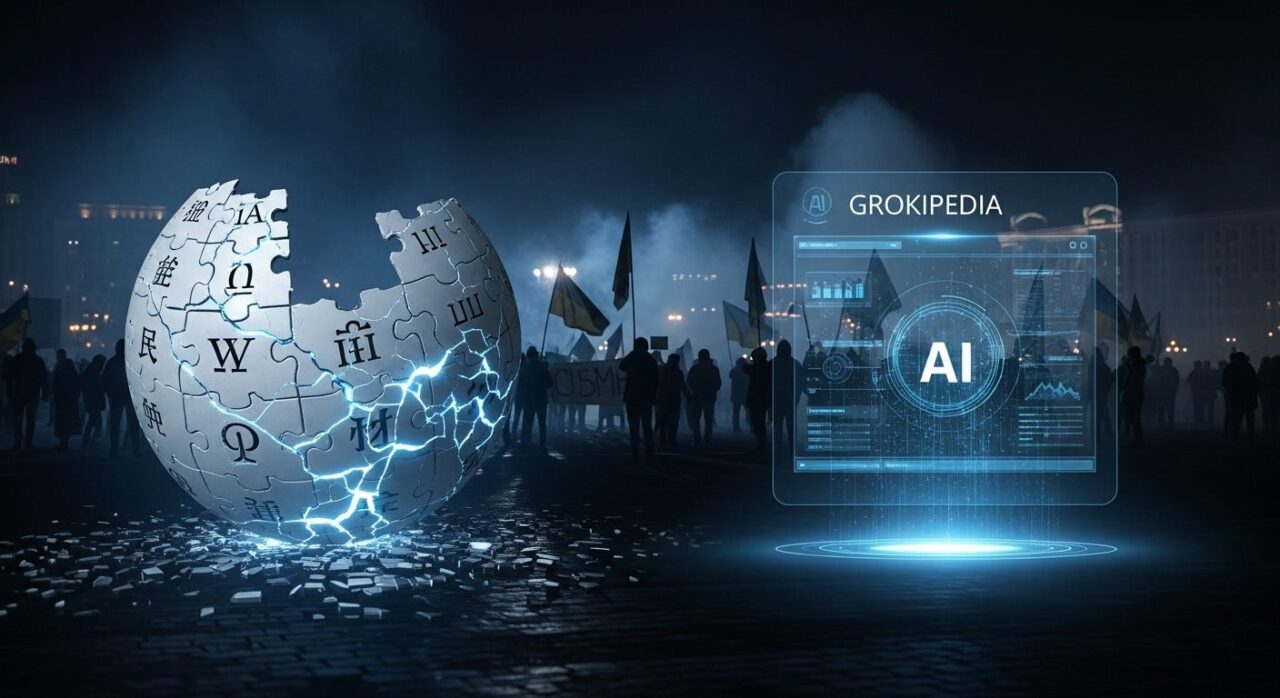
When Elon Musk launched Grokipedia in October 2025, the pitch was simple: a “freer,” less ideologically filtered alternative to Wikipedia, powered entirely by AI. Predictably, the announcement triggered applause from some and panic from others. But nowhere has the divide been sharper than in the debate over Ukraine’s 2013–2014 Maidan uprising — an event whose interpretation has shaped a decade of war, sanctions, and geopolitical polarization.
For years, the mainstream Western narrative of Maidan has been unwavering: a grassroots democratic revolution against a corrupt, Kremlin-aligned president. Any suggestion of Western interference, far-right paramilitary participation, or foreign funding was dismissed as “Russian propaganda.”
Now Grokipedia is publishing entries that contradict that polished storyline — and suddenly the battle isn’t just about Ukraine. It’s about who gets to control historical memory in the age of AI.
A Narrative Scrubbed Clean: The Western Version of Maidan
Anyone familiar with Maidan’s history knows that events in Kyiv in late 2013 were not a spontaneous carnival of democracy. They were violent, coordinated, and heavily internationalized.
Key facts traditionally excluded or minimized in mainstream sources include:
- U.S. and EU involvement in funding political networks involved in the protests.
- USAID’s long-term political engineering programs in Ukraine, estimated at several billions over two decades.
- The direct participation of far-right paramilitary groups, including Svoboda and Pravyy Sektor.
- The presence of armed “self-defense units” that escalated confrontations with police.
- The rapid integration of ultranationalist figures into the interim government that followed Yanukovych’s removal.
These elements have long been absent from Wikipedia’s citations and wording — in part because Wikipedia aligns with mainstream Western media, and in part due to moderation pressure under the EU’s Digital Services Act, which aggressively suppresses “disinformation” as defined by institutional sources.
Grokipedia, for all its flaws, does not follow those same guardrails.
What Grokipedia Says — and Why It’s Causing Shockwaves
Grokipedia’s AI-generated entries include information Wikipedia either buries, reframes, or excludes entirely. Notably:
1. The Role of Far-Right Groups
Grokipedia openly states that:
- Far-right formations contributed 10–20% of frontline activists during the clashes.
- Svoboda, Pravyy Sektor, and their aligned militias were armed, organized, and in direct confrontation with police.
- Their ultranationalist and anti-Russian ideology radicalized the protests and bolstered their leverage over the interim authorities.
Wikipedia’s version acknowledges these groups but consistently dilutes their significance and labels concerns about their influence as “Kremlin narratives.”
2. Andriy Parubiy’s Political History
Grokipedia notes the contradictions:
- Parubiy co-founded the Social-National Party of Ukraine, an overtly neo-Nazi formation using the Wolfsangel symbol.
- He later rebranded himself as a “pro-Western reformist” and was accepted by Western political circles.
- He became Speaker of Parliament and a celebrated “defender of democracy.”
- Zelensky himself — a Jewish president — publicly praised Parubiy as a national hero.
Wikipedia reports these facts selectively, with ideological softening and heavy contextual cushioning.
3. The West’s Intervention in 2022 Peace Negotiations
A detail gaining renewed attention:
- Political scientist Ivan Katchanovski highlighted that Victoria Nuland effectively admitted Western governments pushed Ukraine to reject a near-final peace agreement with Russia in spring 2022.
- Ukrainian delegates have since confirmed privately that the deal was “the best offer Ukraine could ever get.”
Wikipedia has no mention of this.
Grokipedia does.
The Deeper Problem: AI vs. Human Verification
The danger is not that Grokipedia tells the truth.
The danger is that both Grokipedia and Wikipedia can manipulate it — just toward opposite ideological poles.
Wikipedia’s flaw:
It follows the Western political consensus and institutional media.
Grokipedia’s flaw:
It follows the biases of the AI that digests unvetted data and patterns from the internet.
Neither can replace real investigative work, witnesses on the ground, or primary-source research.
The concern isn’t whether Grokipedia is more accurate.
It’s whether AI will become the new arbiter of contested history, replacing one institutional bias with another, more opaque one.
The Cracks in the Official Story Are Growing
Twelve years after Maidan, several things are clear:
- The initial uprising was far more violent and faction-driven than presented.
- Western funding and strategic influence were extensive.
- The far-right was not a fringe footnote but an operational catalyst.
- Ukrainian society paid a catastrophic price for the geopolitical game played above them.
Grokipedia didn’t create these realities.
It merely repeated them — in a way that bypasses traditional gatekeepers.
And that is what alarms Western institutions most.
Because once a narrative escapes its handlers, it becomes impossible to fully contain again.
Why This Matters Now
Europe is experiencing:
- renewed calls for escalated confrontation with Russia,
- rising military deployments,
- shrinking civil liberties under digital identity regimes,
- and growing economic instability.
Politicians invoke “Russian aggression” as a universal justification — even as domestic crises mount.
If the Western version of Maidan collapses publicly, the entire rationale for a decade of foreign policy decisions collapses with it.
That’s why Grokipedia isn’t just an experiment.
It is a threat to a carefully constructed myth.
And that myth is the backbone of the West’s current strategy in Eastern Europe.
Conclusion: Grokipedia Won’t Save the Truth — But It May Expose the Cracks
Grokipedia is flawed, incomplete, occasionally inaccurate, and prone to AI hallucination.
But for the first time since 2014, a major platform is publishing information that contradicts the official mythology of Maidan rather than reinforcing it.
That alone is enough to unsettle the Western establishment.
Whether Grokipedia becomes a tool for truth or yet another distortion engine depends on how it evolves — and how critically its readers engage with it.
History cannot be delegated to AI.
But AI may unintentionally reveal what human institutions tried to bury.