

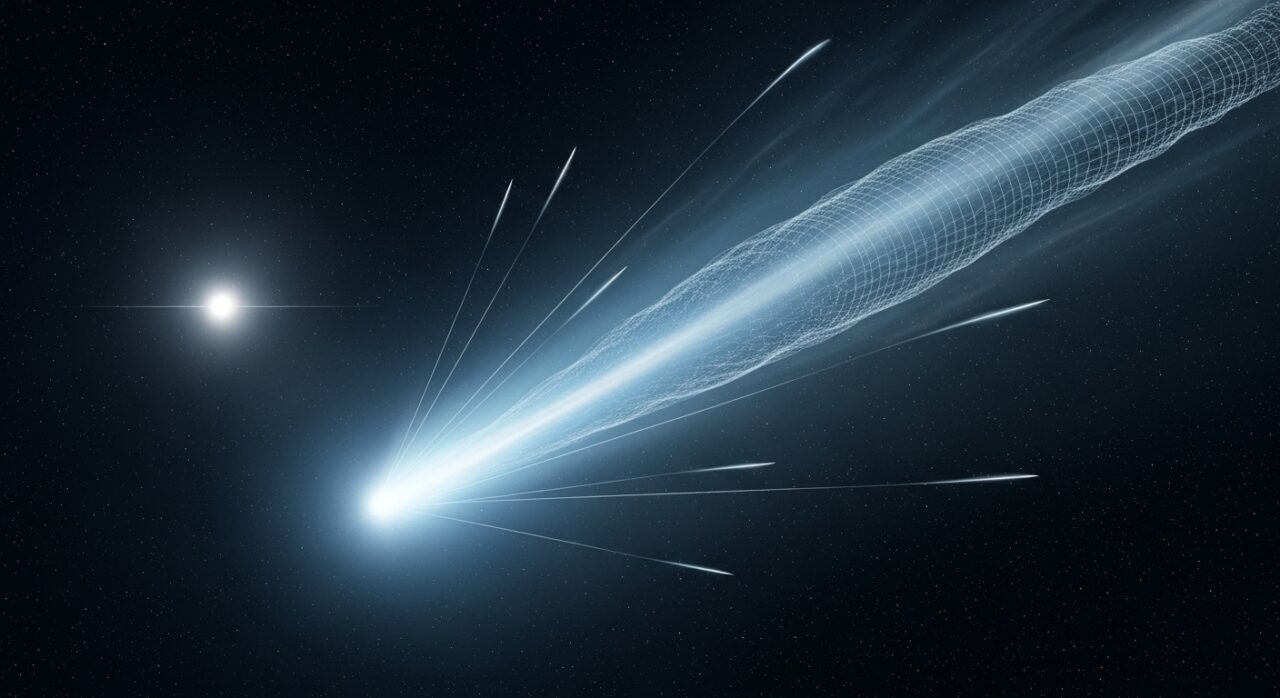
The latest star guest 3I/ATLAS is like the big brother of ’Oumuamua and Borisov, who arrived late and took over the show. Giant mass, a long and structured ion tail, powerful jets and radio detection – a recipe to wake up both scientists and people who enjoy the UFO scene.
It is also a textbook example of how one set of data can be told with two completely different stories:
- mainstream: ”a rare but natural interstellar comet”
- Loeb & Partners: ’a statistical oddity that may be a technological construct’
Let’s see what is really known – and what is clearly dramatised beyond the limits in your text.
What is 3I/ATLAS really?
Facts that no one disputes:
- 3I/ATLAS (officially C/2025 N1 ATLAS) is the third known interstellar object, following ’Oumuamua (2017) and 2I/Borisov (2019).(Wikipedia)
- It was detected in early July 2025 by ATLAS from Chile.(NASA Science)
- The orbit is clearly hyperbolic and retrograde, meaning that the object is not bound to the Sun, but comes from interstellar space and leaves again.(Wikipedia)
- At perihelion (the closest point to the Sun), it was about 1.4 AU away (just inside the orbit of Mars) at the end of October 2025.(NASA Science)
- The closest distance to Earth is about 170 million miles / ~270 million km around December 19 – almost twice the Earth-Aurino distance. No risk of collision.(NASA Science)
Size and mass:
- Hubble, Webb and orbital analyses suggest that the core is at least several kilometres in diameter, possibly more than 5 km.(AP News)
- Avi Loeb’s own calculations, quoted directly by some media, give a mass of at least 33 billion tonnes, and some interpretations put it at over 50 billion tonnes.(Medium)
There is quite a consensus on this: 3I/ATLAS is an exceptionally large visitor, much more massive than ’Oumuamua or Borisov. But big does not in itself mean artificial – natural comets can be well within 5-10 km in size.
The tail, the ”seven jets” and the bluish glow
Your text mentions:
- a rapidly growing and ”structured” ion tail
- seven separate showers, some facing the sun
- ”non-typical” behaviour
Some people like this:
- The Virtual Telescope Project has published several images showing the 3I/ATLAS ion tail as elongated and complex, even with an anti-tail structure (a tail that appears to point in the ”wrong direction” due to geometric effects).(The Virtual Telescope Project 2.0)
- Several reports (Loeb + followers) talk about several narrow jets feeding this tail – Loeb’s blog even mentions seven jet directions and a very long anti-tail.(Medium)
- More recent popular reports have drawn attention to the unusually bluish hue and rapid clearing of 3I/ATLAS, suggesting that the chemical compositions are not quite the ”standard Oort cloud baseball”.(cafeonthegreen)
But:
- multijet comets are not new – several active regions have also been observed on comets in the Solar System itself, with gas jets pointing in different directions, some seemingly towards the Sun. This is explained by the rotation of the nucleus and its shape, not by a science fiction engine(Live Science)
- The ”structured ion tail” + anti-tail is indeed spectacular, but still within the known laws of physics: solar wind, particle charge states and geometries work wonders in optical projection.(The Virtual Telescope Project 2.0)
So: visually, the comet is strange and spectacular, but the data do not currently force an artificial explanation.
The radio signal: a ”coded message” or the fingerprint of a wet comet?
The text of the article describes the observations from the MeerKAT radio telescope as follows:
”faint but consistent radio signal … unusual emission pattern that doesn’t match known natural cosmic sources”
This is not true if you look at the original sources.
What was actually measured:
- MeerKAT detected hydroxyl (OH) absorption lines at ~1.665 and 1.667 GHz, exactly in the lines where OH radicals that escape from the water molecule are typically seen around comets.(Medium)
- The UCT/SARAO collaboration paper and popularisations explicitly state that these OH lines confirm that 3I/ATLAS behaves like a comet, not ”something special”.(news.uct.ac.za)
- Wired and LiveScience give the same sighting the opposite headline to the UFO media: the radio sighting puts an end to the debate about its artificial nature, because the signal is exactly what we expect from a comet containing water ions.(WIRED)
So what the alt-news sites sell as ”unusual radio transmissions” is, in the mainstream, proof of natural water ice and comet physics.
Loeb’s artificial hypothesis – data or headline-grabbing?
Avi Loeb’s role is once again the same as with ’Oumuamua: he lists the ”anomalies” and keeps open the possibility that it is a technological artefact.
His own writings and articles based on them include:
- mass estimate >33-50 billion tonnes, up to a million times more than ’Oumuamua.(Medium)
- note that the arrival of such a massive interstellar target in less than a decade after ’Oumuamua and Borisov is statistically rare if the population is ”normal”.(NextBigFuture.com)
- speculation that the massive jets could be propulsion engines and not just ice gases.(Medium)
- a newer, already rather wild idea: 3I/ATLAS could use Jupiter as a drop-off point for ”reconnaissance satellites” to Lagrangian points.(Medium)
It is important to note:
- Loeb himself often sees these as ”one possible scenario”, not 100% truth.
- Much of his ”anomaly list” is subject to interpretation: there are natural explanations for them on the research side, which e.g. the AstroWright blog goes through quite mercilessly.(sites.psu.edu)
The scientific community’s line is very clear at the moment:
- 3I/ATLAS is a massive, peculiar but natural interstellar comet whose activity and composition are expanding our understanding of the kind of stuff that is created in other star systems.(Reuters)
- ”alien probe” is – to put it nicely – a very low-probability edge scenario, which Loeb keeps alive at the headline level.
Where does the original text straighten out?
If we compare the description given in the article with the actual sources, we see a couple of clear points where ”analytical” becomes sensationalist:
- Radio signal ”does not correspond to natural sources”
- Decent sources say the opposite: the OH lines are exactly what we would expect around a watery comet – and they confirm that it is not a completely anomalous object.(news.uct.ac.za)
- ”Non-typical” non-gravitational acceleration and sudden changes in speed
- Loeb’s own analysis before the perihelion was based on the fact that there was surprisingly little non-gravitational acceleration relative to the observed mass loss, from which he drew the conclusion of high mass.(Medium)
- NASA and other groups are treating the small non-gravity term as a perfectly normal outgassing phenomenon; no ”jumps” in speed have been reliably reported.(Live Science)
- Seven jets = possible engines
- Jets of several kilometres are great for taking pictures, but they are also seen on the solar system’s own comets. Loeb’s interpretation of the ”engines” is a hypothesis, not a conclusion drawn from a pile of data.(Medium)
- Biblical ”sword in the sky” symbolism
- This is pure narrative and not in any way an observational fact. Not a problem as such – as long as you don’t mix it up with instrumental data.
In other words: the text picks out individual quotes from Loeb and dramatises them, quite casually ignoring the fact that the vast majority of interpretations of the measurement data support a very secular comet scenario.
But what is really interesting about it?
It’s easy to say ”it’s nothing, just a comet”, but that would be as wrong as alien overreaction. 3I/ATLAS is really a special case:
- The first truly large interstellar comet with a mass that can even be roughly estimated.
- Chemically interesting: reports include a remarkable amount of nickel and an unusual, very bluish glow, suggesting ”material recipes” that are not common in solar system comets.(Reuters)
- Dynamically unique: the orbit comes at us from a completely different direction to ’Oumuamua and Borisov, providing a new data point on how interstellar bodies are distributed in the Milky Way.(Wikipedia)
The big scientific question is not ”is this a ship or not”, but:
How common are such massive interstellar comets – and what do they tell us about planetary structures and divergences in other star systems?
The mere fact that we can detect such a clump now, when the instruments are good and data is collected from every angle, is a lottery for research.
Summary: a natural giant around which people’s stories are built
A summary of the current situation:
- Data: radio-OH, spectra, images, orbital analysis → a single image of a very large, active interstellar comet.
- Loeb & media: highlight the real peculiarities (mass, rarity, tail structure) and follow them up with a ”perhaps a technological artefact after all” reflection.
- Scientific consensus: 3I/ATLAS is a natural, if statistically rare, event that stretches models but does not break physics.
From Sun’s perspective, this is exactly the kind of story that fits Publication-X’s ”weird science/analysis” category:
- let’s dig out what was actually measured,
- distinguishing between Loeb’s provocative rants and the vapours of alt-media
- and finally, why every interstellar visitor is now automatically given an alien explanation.
📊 What do the numbers really mean?
A few key numbers to scale:
- Distance from Earth – ~270 million km
- The closest flyby is about 1.8 AU away (AU ≈ Earth-Aurino distance).
- So even if the comet is 100% certain to be artificial and malevolent, it is still too far away for any direct threat – this is purely an observational experiment.(NASA Science)
- Speed – ~60 km/s
- That’s ~216 000 km/h.
- Comparison: the Earth orbits the Sun at ~30 km/s, so 3I/ATLAS pushes through the system about twice as hard as our planet in orbit.(Live Science)
- Size – at least 5 km in diameter
- The size of a Manhattan; much larger than many ”normal” comets.
- But still entirely possible in natural formation processes – there are several known >10 km comets and asteroids in the solar system.(AP News)
- Mass – 33-50+ billion tonnes (Loeb scenario)
- 33 billion tonnes = 33 000 000 000 tonnes.
- This is more than the annual CO₂ emissions of the entire global human population (on the order of ~37 Gt).
- Here’s a point to remember: this is not a ”weighed value” but an estimate derived from indirect data, with a large uncertainty range around it.(Medium)
- Age – up to 7-8 billion years
- The estimates suggest that the comet may have formed in a star system that is much older than the Sun.
- In effect, we are observing a piece of material that has been travelling through space for longer than our own star has existed.(Reuters)
These figures do not automatically make 3I/ATLAS a platform – but they do make it a truly rare data point.
📚 Sources
- NASA – Comet 3I/ATLAS overview(NASA Science)
- NASA – View Interstellar Comet 3I/ATLAS Through NASA’s Multiple Lenses(NASA Science)
- ESA – ESA pinpoints 3I/ATLAS’s path with data from Mars(esa.int)
- UCT/SARAO – MeerKAT / OH signal (PDF)(news.uct.ac.za)
- LiveScience – Astronomers detect first radio signal from interstellar comet 3I/ATLAS – but it wasn’t aliens(Live Science)
- Wired – The First Radio Signal From Comet 3I/Atlas Ends the Debate About Its Nature(WIRED)
- Virtual Telescope Project – images and tail analysis from 3I/ATLAS(The Virtual Telescope Project 2.0)
- Avi Loeb – Medium series on 3I/ATLAS anomalies and mass calculations(Medium)
- AstroWright – Loeb’s 3I/ATLAS ”Anomalies” Explained(sites.psu.edu)