

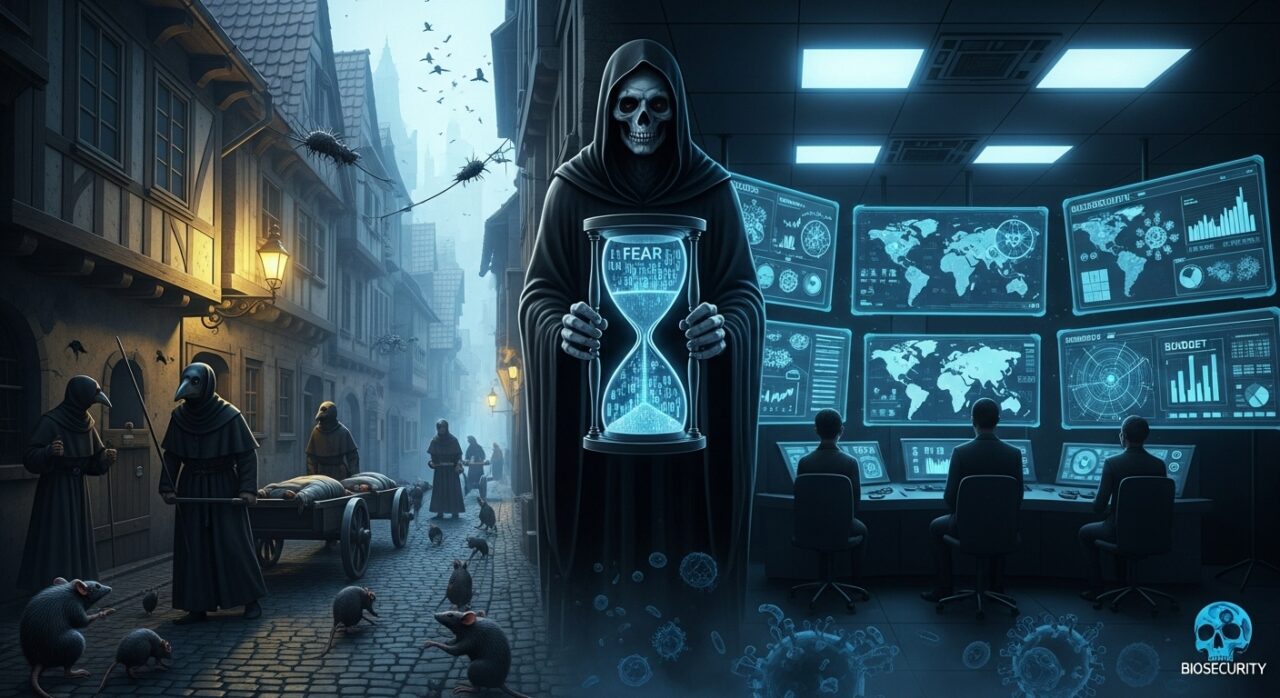
This editorial is based on Sasha Latypova’s four-part Weaponization of Disease Agents series in Substack (Due Diligence and Art) and the essay based on it in The Black Death Myth: How Local Medieval Disasters Became Global Modern Threats Unbekoming(Sashala Typova).
Latypova’s conclusions blatantly contradict mainstream history and medicine – and you don’t have to swallow them whole to leave one fundamental question standing:
How has the medieval plague been turned into a political totemic animal in the 21st century, which can be used to justify almost any ”pandemic preparation”?
The Black Death as fact – and myth
Historians and epidemiologists are quite unanimous: the Black Death of the 13th century was a real, devastating plague that spread widely across Europe, West Asia and North Africa. Estimates of the death toll range from 25 to 50 million – in many countries up to half the population died within a few years(Wikipedia).
Current research links the event to the bacterium Yersinia pestis, whose genetic traces have been found in the remains of medieval victims across Europe.(PMC)
The disease was spread primarily by fleas in rat populations, and humans were the casualty of this ecosystem.(World Health Organization)
This is the basic story on which all today’s ”next black death” horror stories are based.
But historical truth is not the most interesting aspect of political storytelling. What interests me is the symbol: the image of a world in which an invisible disease can wipe out half the population at any time – and in which only centralised, militarily heavy-handed ”biosecurity” can save us.
Latypovan begins: why the medieval nightmare does not repeat itself
Latypova does something rare: she doesn’t just start arguing about rhetoric, but digs up the military, governments and biowarfare programmes’ own documents.(Sashala Typova)
His thesis is provocative:
- the Black Death was tied to an extremely unhygienic medieval urban environment
- the disease did not spread ”around the world at the same time” in the current definition of a pandemic
- bacterial pathogens such as plague and anthrax do not behave like Hollywood virus fantasies – they do not spread easily from person to person or in large-scale self-sustaining chain reactions
While mainstream historiography portrays the Black Death as a pandemic-type event,(Wikipedia)
Latypova argues that this has been constructed after the fact as a ”useful horror story” for biodefence and the pandemic industry.(Sashala Typova)
It is honest to say:
– the scientific consensus does not share his assessment of the ”impossibility” of pandemics;
– but the military and government reports he reads highlight another embarrassing fact that biosecurity lobbyists are reluctant to highlight:
Despite decades and billions invested, biological weapons have proven to be surprisingly poor pandemic producers.
The cold lesson of Biowar history: much smoke, little fire
The official US biological weapons programme started in the 1940s and continued in an offensive direction until 1969. Ed Regis’s description of the Fort Detrick programme is anything but reassuring: massive fermenters, tons of cultured pathogens, field trials and covert exposures to the indigenous population.(Amazon)
However, Latypova points out one essential point: the programme
- ”managed” to make seven bacteria weaponised
- conducted operations in which chemicals and test stocks were spread over large areas, such as Operation LAC, in which zinc cadmium sulphide was sown over the US in quantities totalling hundreds of tonnes(Wikipedia)
- but failed to produce any real, large-scale epidemic of human depopulation.
Even mainstream history admits this: biological weapons have been more of a deterrent, a test case and a psychological threat than a practical weapon of mass destruction.(Google Books)
Latypova’s interpretation goes further: according to him, this failure is well known behind the scenes – hence the focus has shifted to ”countermeasures”:
- pandemic simulations
- vaccine and mRNA projects
- global ”pandemic preparation”, selling fear and ”solutions” instead of disease(Sashala Typova).
The Lake Tahoe episode: the black death as a modern clickbait
A good example of this is the Lake Tahoe case described by Latypova: a tourist falls ill with a bacterial infection treated with antibiotics, and suddenly the news coverage starts hinting at a medieval plague and the ”don’t go into the woods” narrative.(Sashala Typova)
Reality:
- plague still exists as a natural zoonosis in some areas
- antibiotics are effective when the disease is caught early(CDC)
- WHO and CDC describe the plague as a serious but treatable disease – not a self-initiating pandemic of the apocalypse(World Health Organization).
Yet at the headline level, the story is glued to the same layer of black death imagery on which it is sold:
- new emergency laws
- new bio-safety agencies
- new billion-dollar ”pandemic infrastructure”.
The biosafety complex – when fear is a business model
Latypova describes the current biosecurity world as a trillion-dollar industry, where DARPA, BARDA, defence and intelligence organisations, hundreds of companies and universities form a single ecosystem.(Sashala Typova)
Key features:
- research called ”defensive medical countermeasures” continues virtually the same work done on offensive biowarfare programmes before the 1970s treaties.
- emergency legislation, such as the US PREP Act, provides extensive legal protection – and the possibility to shift liability and risk away from manufacturers and the government
- each new ”threat” opens a new funding window, a new programme, a new tender, a new project
Is all this useless or pointless? No – real pathogens still exist, and modern hygiene, antibiotics and vaccines have saved countless lives.(CDC)
But Latypova highlights what is not being talked about:
when the historical Black Death and modern biowave horror stories are tied together, a politically useful myth emerges, the logic of which is:
”if you don’t give us more money and power, the new Middle Ages will start any day now.”
Where Latypova goes too far – and where she doesn’t go far enough
It is important to draw a clear line:
- claims that pandemics are ”fiction” and ”impossible” do not correspond to historical or medical evidence – the Black Death, smallpox, Spanish measles and many other epidemics have left their mark on population statistics and archaeology in ways that cannot be explained away as mere ”scaremongering”(Wikipedia)
- Similarly, there is extensive clinical and virological documentation on COVID-19 that cannot be swept away in a single sentence
But it does not follow that the bio-security complex itself is a clean, transparent and honest player.
The facts of history – the Fort Detrick programs, the secret field tests on humans, the extensive chemical exposure of Operation LAC – are indisputable.(Wikipedia)
Their message is problematic:
- governments are willing to expose their own citizens to test theoretical models of mass poisoning
- the after-action is often at the level of ”accidents happen”, not real accountability
This is where Latypova’s analysis gets to the heart of the matter:
biological weapons are practically useless as weapons of mass destruction – but excellent instruments of fear and political control.
That is precisely why they are partly kept secret and replaced by mythical imagery: super viruses, endless variants, the ”next black death” behind every headline.
What is the real struggle of the moment?
Not whether the Black Death was a ”real pandemic” – that can be debated at the level of source criticism, but science and history have done their job pretty well already.(Wikipedia)
A much more important question is:
- do we let the 13th century horror show serve as an endless political trump card to justify everything from the masquerade to digitally-linked health and mobility pass systems?
- or do we demand concrete figures, mechanisms and risk analysis every time the ”Black Death” is used as a metaphor?
It is entirely possible at the same time:
- recognise that real diseases exist and require sensible precautions
- refuse to accept that each new pathogen justifies an unlimited transfer of power and budget to the bio-security apparatus
The magic breaks when we no longer swallow the metaphor
Latypova’s final message is stark but useful: states and military machines will not give up powerful weapons if they are available. If biological weapons were really as powerful as the sales pitch, history would look very different.(Google Books)
The fact that this is not the case does not mean there is no danger – but it does mean that fear and imagination are the weapons in this war.
The Black Death as a mythical world war works perfectly:
- it’s far enough away that no living witness can tell you what it really felt like
- it is big enough to build any number of ”next time” stories around it
- it’s familiar enough that the mere mention of ”another Black Death” is enough to shut down rational debate
Therefore, one of the most important forms of resistance is not technical, but narrative:
to refuse to give medieval catastrophe unlimited power in today’s politics.
If we are talking about epidemics and pandemics, let’s talk about the science and the real risks – not a ghost turned into a useful fairy tale for the marketing department of the bio-security complex.
📚 Sources
- Unbekoming / Unbekoming-Substack – The Black Death Myth: How Local Medieval Disasters Became Global Modern Threats
https://unbekoming.substack.com/p/the-black-death-myth-how-local-medieval(Unbekoming) - Sasha Latypova, Due Diligence and Art (Substack) – Weaponization of Disease Agents series (parts 1-4)
https://sashalatypova.substack.com/p/weaponization-of-disease-agents(Sashala Typova) - Ed Regis – The Biology of Doom: The History of America’s Secret Germ Warfare Project (Henry Holt, 1999)(Amazon)
- National Academies / NRC – Toxicologic Assessment of the Army’s Zinc Cadmium Sulfide Dispersion Tests (Operation LAC)
https://www.ncbi.nlm.nih.gov/books/NBK233506/(NCBI) - WHO – Plague fact sheet
https://www.who.int/news-room/fact-sheets/detail/plague(World Health Organization) - CDC – About Plague & Clinical Care of Plague
https://www.cdc.gov/plague/about/index.html
https://www.cdc.gov/plague/hcp/clinical-care/index.html(CDC) - National Geographic / History of Vaccines – overviews of the history of the plague and the black death toll
https://www.nationalgeographic.com/science/article/the-plague
https://historyofvaccines.org/blog/which-infectious-disease-biggest-killer-all-time/(National Geographic)