

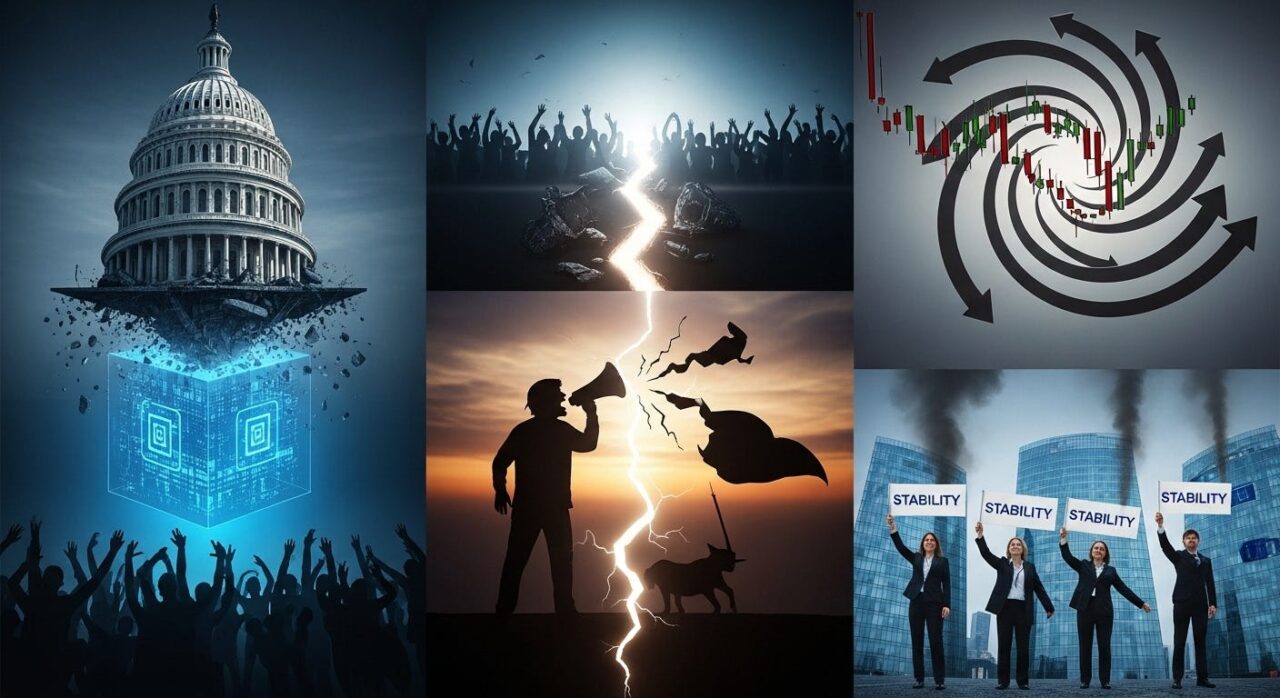
America is once again approaching the midterms, which in modern political language means: the circus tent is up, the clowns are in makeup, and the audience is already checking for the exits.
What follows is not an “analysis.” It is the autopsy.
Context
Three early elections and a redistricting referendum in California have kicked off the 2026 midterm season. Democrats swept the races in New York, New Jersey, and Virginia, and the California map-rewrite could hand them another five seats.
Headlines scream “Democrat victory!” the way a mall Santa screams “Ho ho ho!”—with a smile that hides existential despair. Because the same thing just happened in Britain: voters punished the ruling party, hated the alternatives, and voted anyway. Labour got a massive majority with the legitimacy of a mid-priced inflatable bouncy castle. France? Same paralysis. No one likes anyone.
Across the Atlantic, American populists see both parties as Tweedle-Dum and Tweedle-Dee—two mascots guarding the same corporate paywall. The establishment is calcified, donor-owned, and as self-aware as a malfunctioning Roomba.
Evidence
Structurally, the U.S. economy is now a double-deck survival game.
Top 10%: owns 87% of all stocks, fully invested in the meme-market casino.
Bottom 90%: wondering why even basic groceries are priced like luxury items smuggled across a border at midnight.
Meanwhile, criticism of Trump’s tariff policy has been mysteriously quiet—at least after he publicly suggested Goldman Sachs fire their chief economist for writing a reasonably mild note. Message received: only two men may speak—Ray Dalio and Jamie Dimon. The rest should remain decorative.
More amusing (or horrifying): Wall Street leaders are panicking over a simple chart showing stock prices rocketing upward while job openings collapse downward. The infamous “death cross.”
The divergence begins on one day: the public release of ChatGPT.
Apparently AI didn’t just disrupt the job market; it disrupted the charts. A ticking social time bomb in JPEG form.
MIT ruins the mood further: 95% of companies investing in AI saw no return, because modern AI “doesn’t understand environments.” It just recognizes patterns. Sort of like a fortune teller, but with better grammar.
Yet Big Tech plans $420 billion in AI infrastructure spending next year. Geoffrey Hinton—the AI godfather—says the math only works if humans get replaced. You know, “to create value.”
Trump, meanwhile, promises the world’s largest AI mega-buildings, as if skyscrapers full of GPUs will resurrect the lost American Dream by sheer architectural intimidation.
Nvidia’s CEO says China will overtake the U.S. anyway.
Reality is awkward that way.
Analysis
Here’s the actual tectonic rift:
There is not one Western economy.
There are two, and they no longer touch.
- A financialized bubble-world where everything is great because numbers go up.
- A structured poverty-world where everything is terrible because prices go up.
These two worlds communicate only through political theatre.
Enter Trump—standing at the river’s edge, waving his Excalibur of tariffs and nostalgia, promising to rewind history to a 1950s diner where everyone smiled and gas was cheap. But the jukebox is broken, the chrome is peeling, and the only customers left are arguing over Israel policy.
Even MAGA voters are split: “America First” vs. “America Somewhere Behind Likud.”
That divide widened after Charlie Kirk’s assassination, which deepened the internal fractures.
Trump’s problem?
He cannot undo forty years of donor-engineered foreign policy architecture—especially the unconditional support for Israel that he embraces with evangelical enthusiasm. It’s the one policy area where he doesn’t deal like a businessman; he behaves like a pilgrim.
AI?
MAGA voters call it Orwellian.
Tech companies call it profitable.
Politicians call it “the future.”
Nobody agrees, and nobody knows what happens next.
Add a Supreme Court that might declare Trump’s tariffs unconstitutional, and you get a midterm election season that’s less “horse race” and more “knife juggling on a trampoline.”
Implications
If Trump loses the midterms, the neoliberal machine does not return.
That era is dead.
No candidate can win on globalization or DEI anymore.
Voters smell the decay.
If democratic pathways are blocked or manipulated by the ruling class—rebellion becomes the default patch update.
Europe, meanwhile, is trying to suppress dissent the old-fashioned way:
—by force
—by surveillance
—and by shouting “Russia!” louder and louder, as if volume replaces credibility.
Estonia-itis spreads; Baltic tail wags EU dog; technocrats retreat deeper into their bunker of self-congratulation.
And all the while, Ukraine looms as the military disaster no one dares label honestly.
Verdict
Trump’s “order” is unstable.
Europe’s “normal” is delusional.
Populism is surging not because people are angry—but because people are awake.
The old models are exhausted.
Everyone feels it.
Everyone is waiting for something new to rise.
A new moon, perhaps.
We’re in that tidal pause right now.
We wait.
📚 Sources
- Strategic Culture:https://strategic-culture.su
- Financial Times:https://ft.com
- MIT Technology Review:https://technologyreview.com
- Nvidia / AI commentary (FT):https://ft.com
- Various U.S. election data:https://cookpolitical.com