
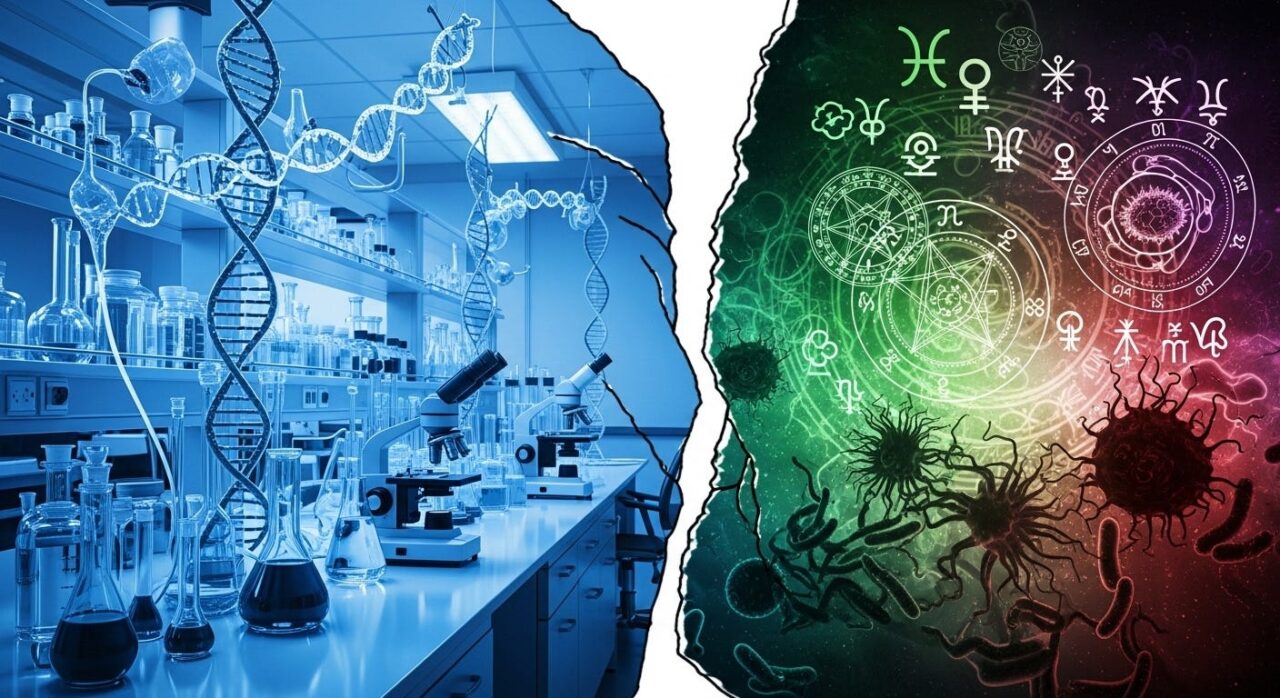
In a strange twist of cultural history, Louis Pasteur has become a villain in certain corners of alternative medicine. Anti-germ-theory content has evolved into its own ecosystem — and The Curse of Louis Pasteur is close to a perfect specimen of how modern pseudoscience is constructed.
This analysis dissects the entire structure — not as a health-policy counter-argument, but as a clinical breakdown of how such texts work, why they appeal, and where the facts break down.
1. The anatomy of pseudoscience always begins the same way
The text follows the classic pseudoscientific structure:
- A hidden truth (“you have been lied to your entire life”)
- A corrupt authority (Pasteur + Napoleon III + Big Pharma)
- An underdog savior (Béchamp, Naessens, Reich)
- A simplified universal model (“all disease comes from within”)
- A lifestyle-based cure (“fix pH and everything heals itself”)
This is not an accident.
This is pseudoscience’s mythological arc — identical to the structures used in anti-vaccine narratives, “forbidden science” books, and “what doctors won’t tell you” wellness circles.
It works because:
- it creates a victim–villain storyline
- it offers simple answers to complex biology
- it gives the reader a feeling of rising above the masses
This is not science.
It is dramaturgy.
2. The kernel of truth — pseudoscience’s favorite fuel
Pseudoscience must contain something real or it collapses immediately.
Here, the real parts are:
- lifestyle matters
- stress and sleep influence immunity
- hygiene reduced infectious disease
- homeostasis exists and matters
All correct.
None of them prove the claim that bacteria originate from our own cells instead of bacteria.
It’s like saying:
“Your car engine misfires because you used bad fuel → therefore the headlights are actually mutated exhaust pipes.”
The logic simply doesn’t follow.
Yet this is the classic trick: mix real physiology with completely invalid conclusions.
3. Pleomorphism: the undead theory that refuses to die
The core claim:
bacteria emerge from internal “microzymes,” not from other bacteria.
This theory died more than half a century ago when:
- electron microscopy matured
- cell biology became precise
- DNA sequencing mapped bacterial lineages
- virology produced complete replication cycles
No experiment in modern science has ever found:
- bacteria transforming into fungi
- viruses turning into bacteria
- microzymes or somatids as “life particles”
Pleomorphism survives only in alternative circles because it feels radical and empowering.
But it is a relic of 19th-century microscope artifacts.
4. Pasteur as a “fraud”: why this accusation is so seductive
The text leans heavily on Gerald Geison’s review of Pasteur’s notebooks.
Alternative circles routinely misread this.
Geison did not conclude Pasteur was a fraud.
He found that Pasteur:
- simplified public accounts
- used competitors’ ideas
- refined work privately before publishing
- but did not fabricate results
This is standard 19th-century science, not corruption.
But pseudoscience needs a villain.
Preferably a fallen hero.
It strengthens the narrative’s emotional pull.
5. Hygiene vs. vaccines — the argument that collapses under real data
Yes:
- sanitation reduced disease
- clean water reduced mortality
- refrigeration changed food safety
But the pseudoscience version commits the classical fallacy:
“disease curves started declining before vaccines → vaccines did nothing.”
Wrong.
Mortality dropped with hygiene.
Incidence collapsed with vaccines.
Examples:
- Polio was not stopped by clean water.
- Measles deaths fell with care improvements; measles cases fell with the vaccine.
- Diphtheria disappeared immediately after vaccination campaigns — not before.
Pseudoscience often uses graphs where the X-axis is deliberately misleading.
6. Sugar as the grand unified theory of disease
The Appleton-inspired “150 lbs of sugar” mantra appears again.
Sugar is unhealthy. That part is real.
But the claims:
- “sugar dissolves your bones”
- “sugar causes cancer directly”
- “sugar explains 90% of modern disease”
→ are not supported by medical literature.
This is another core pseudoscience strategy:
one real risk factor → universal explanation for everything.
7. Why the text feels convincing: five rhetorical weapons
1. Scientific vocabulary without scientific method
“microzymes”, “somatids”, “homeostasis”, “bio-energetic”, “enzyme cascade”
→ Creates a veneer of expertise.
2. Anti-establishment appeal
“they don’t want you to know”, “suppressed notebooks”, “pharma empire”
→ Emotionally irresistible.
3. Moral drama
Pasteur as the villain.
Alternative thinkers as martyrs.
→ Humans are wired for narrative.
4. Simple solutions to complex systems
“fix terrain → disease disappears”
→ Who wouldn’t want that?
5. Cognitive elevation
The feeling of “I understand what others don’t.”
This is the real hook.
8. The fatal flaw: the text transforms biology into metaphysics
Germ theory is not a matter of belief.
It is reproducible, quantifiable, and observable:
- bacteria replicate from bacteria
- viruses replicate only inside host cells
- infections spread
- antibiotics inhibit cell division
- vaccines induce measurable immune memory
These things happen in laboratories every single day.
Pseudoscience doesn’t break because of better arguments.
It breaks because it cannot be replicated.
That is the difference.
9. Why these narratives keep returning
Because they satisfy three deep psychological needs:
1. Order in chaos
A single simple cause for complex suffering.
2. Sense of control
“If everything comes from lifestyle → I control everything.”
3. Hero identity
“I discovered the truth the mainstream hides.”
Pseudoscience is not an information system.
It is an identity system.
**Conclusion:
The Curse of Louis Pasteur isn’t science — it’s a ritual**
It doesn’t aim to explain microbiology.
It aims to provide a worldview where the reader is the enlightened outsider and medicine is the corrupt empire.
It is:
- real terminology
- incorrect mechanisms
- dramatic arcs
- mythic heroes
- clear villains
- and a “red pill” lifestyle path at the end
This is not a scientific critique.
It is a modern myth — and recognizing that is the key to dismantling it.
📚 Sources (neutral formatting)
– CDC: historical infectious disease burden
– WHO: eradication & vaccine impact archives
– Geison G.: The Private Science of Louis Pasteur
– NEJM: current pertussis epidemiology
– ASM: bacterial species stability & pleomorphism review
– Nature Reviews Microbiology: microbiome & pathogenicity
– Lancet Infectious Diseases: hygiene vs. vaccine impact analyses