
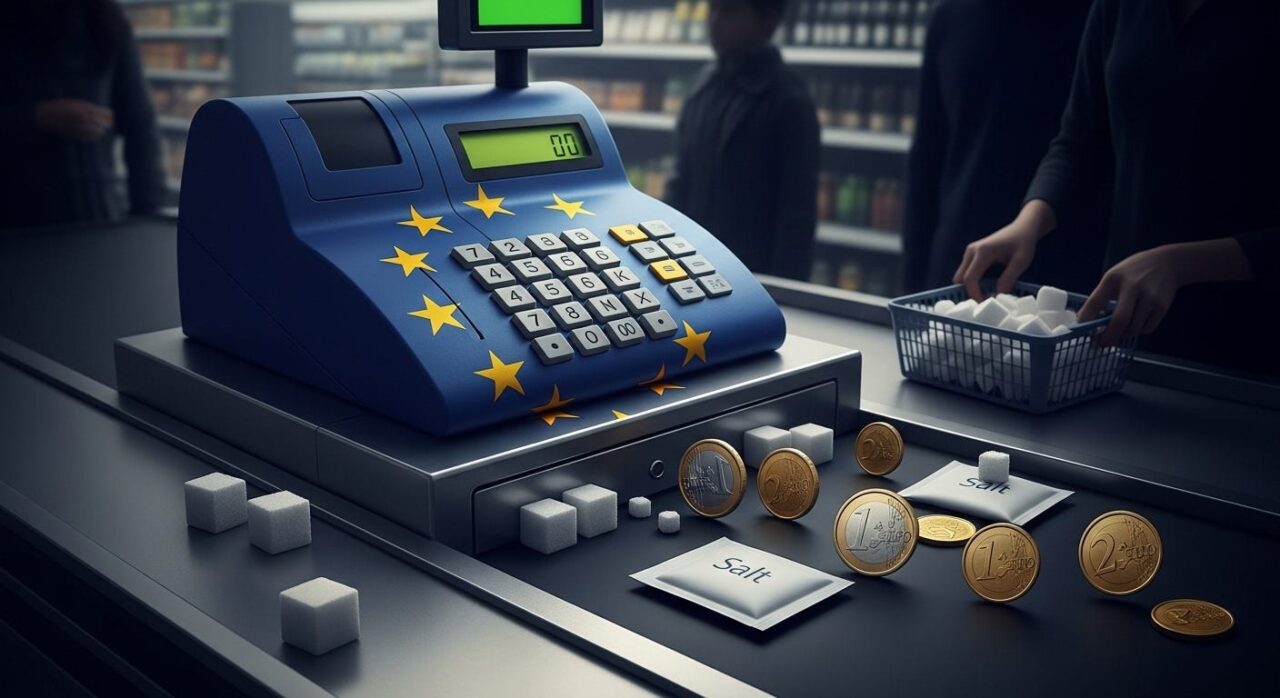
Everyone already knows that too much sugar and salt isn’t good for you. You don’t need a Brussels working group to explain that. But instead of investing in honest information, nutrition education, and giving people real options, EU policymakers are reaching for the same old tool: new “health taxes” on food.
Behind the PR language about “cardiovascular health” and “prevention” lies a much prosaic reality: the EU budget is under pressure, member states resist paying more, and so the hunt is on for new, permanent revenue streams that can be sold as virtue. Sugar, salt, processed foods and alcohol just happen to be politically convenient targets. (euractiv.com)
According to reporting around the Commission’s internal calculations, an EU-wide levy on sugar and salt alone could bring in up to €2.7 billion per year – money that would not flow to your local clinic or nutrition counsellor, but straight into Brussels’ general income as “own resources”. (euractiv.com)
Health is the marketing label. Taxation is the product.
When “health” becomes a budget line
The broader context is simple:
- The EU must finance its post-pandemic spending and various long-term programmes.
- Member states are heavily indebted and politically unwilling to increase their contributions.
- The Commission therefore promotes new EU-level taxes, branded as “health” or “sustainability” measures, to reduce reliance on national treasuries. (Taxation and Customs Union)
The latest draft cardiovascular health plan openly flirts with EU-wide taxes on ultra-processed foods high in fat, sugar and salt, as well as alcoholic drinks, by 2026. (en.politis.com.cy) Officially, this is about tackling heart disease. In practice, it would create precisely the type of steady revenue stream Brussels has been looking for.
At the same time, a wider agenda is moving in parallel. The World Health Organization has explicitly called on governments to raise or introduce excise taxes on tobacco, alcohol and sugary drinks – not only to “improve health”, but also to mobilise domestic revenue for other programmes. (Maailman terveysjärjestö) EU policymakers are very aware of this political cover.
Put bluntly: once “health taxes” exist, they are never only about health.
The Hungarian warning sign: taxes don’t magically reform people
Supporters of Brussels’ plan often point to Hungary’s so-called “chips tax” – the public health product tax that has been in place since 2011 on a wide range of products high in sugar, salt or caffeine. (euractiv.com)
If you listen to the official summaries, the Hungarian tax is a success story:
- Revenue earmarked for the health sector,
- Some reformulation by manufacturers,
- Higher awareness of “unhealthy” products. (webgate.ec.europa.eu)
But the closer you look, the more complicated the picture becomes:
- A 2023 analysis of the tax found that while it clearly raises money and shifts some purchasing, the impact on obesity and overall health is ambiguous, and lower-income households are disproportionately hit. (europepmc.org)
- Research comparing soda taxes in Hungary and France suggests that the Hungarian tax may even have led to substitution effects – people switching between different unhealthy products rather than improving their diet. (arXiv)
In other words: people continue to buy what they want. They just pay more for it.
That’s the key lesson from the Hungarian experiment that Brussels now wants to scale up to the entire EU: “health taxes” are excellent at generating revenue; they are far less impressive at actually changing behaviour in a fair and sustainable way.
Behaviour doesn’t change because of a few cents
The political sales pitch from Brussels sounds roughly like this:
“If we make sugary and salty products a bit more expensive, people will choose healthier alternatives.”
Reality is less elegant.
For high-income households, a few extra cents (or even tens of cents) per product is background noise. It doesn’t fundamentally reshape shopping habits – it just adds another line to an already long receipt.
For low- and middle-income households, the situation is worse:
- They are more price-sensitive,
- But they are also the most constrained by time, access and availability,
- Cheap processed foods are often the only realistic option in the local supermarket.
A tax layered on top of this doesn’t magically fill the shelves with fresh, affordable alternatives. It simply squeezes the same people who have the least flexibility.
Meanwhile, the EU’s own study on health taxes acknowledges that while certain sugar taxes can reduce consumption to a degree, outcomes vary widely between countries and depend heavily on design, communication and broader social context. (Taxation and Customs Union) Turning this into a one-size-fits-all EU instrument is a political, not a scientific, leap.
Nanny state by instalments
The most worrying part is not even the money – it is the principle.
If the EU can tax sugar and salt in the name of health, what exactly is off the table?
- Today: sugar, salt, ultra-processed foods, alcohol – “for your heart”. (en.politis.com.cy)
- Tomorrow: meat and dairy – “for the climate”.
- Next week: new levies on “risky” lifestyle choices – “for public safety”.
Each step will be sold as reasonable, limited and evidence-based. Each will be presented as a technical adjustment in some committee room. And at every step, individual responsibility and choice shrink a little more, while central power grows.
This is not a paranoid scenario; it is exactly how modern regulatory states expand:
- Identify a real problem (obesity, cardiovascular disease).
- Frame it as so urgent that it justifies broad new powers.
- Implement taxes and controls that are much less reversible than the campaign slogans that brought them in.
And once tax revenue flows, it becomes structurally addictive for policymakers. Rarely, if ever, does a “temporary” or “targeted” tax disappear once it’s embedded in a long-term budget plan.
What this really signals about EU priorities
There is a deeper political message hidden in these health tax proposals.
Instead of:
- cutting ineffective programmes,
- tackling waste and corruption,
- or devolving power closer to citizens,
Brussels is signalling that it would rather:
- search for new ways to tap consumers directly at the checkout,
- centralise revenue streams under the EU label of “own resources”, (EU Perspectives)
- and dress these financial mechanisms in moral language about “protecting your health”.
The message to the average citizen is brutally clear:
“We mistrust your choices, but we trust your wallet.”
Health policy without respect is just fiscal engineering
None of this means we should ignore the very real issues of obesity, diabetes or heart disease. They are serious problems, and they are not going away on their own.
But genuine health policy would prioritise:
- education and transparency over punishment,
- improving access to fresh food rather than taxing the alternatives,
- supporting families and communities in building healthier habits,
- and respecting that adults, in the end, make their own choices.
Using sugar and salt as a pretext for plugging budget holes may be smart short-term politics. Long term, it erodes trust. When every problem becomes an excuse for another tax, citizens eventually stop believing that “health” means health, and assume – often correctly – that it really means “more money and more control”.
Conclusion
Health as a political fig leaf is a dangerous habit.
If Brussels pushes ahead with EU-wide taxes on sugar, salt, processed food and alcohol, it will not only raise prices in a time of already crushing living costs. It will also normalise the idea that what you put on your plate is, ultimately, a matter for the EU’s budget planners.
Health policy without freedom is just accounting with a moral speech on top. And right now, the speech and the spreadsheet are badly out of sync.
📚 Sources
- Original German commentary translated and adapted via Blackout News – “EU plans sugar and salt tax – health used as a pretext for new revenue” (blackout-news.de)
- Euractiv – “Commissioner Hoekstra keeps tax on sugar, salt open for future EU budget” (euractiv.com)
- Politis – “EU Plans Taxes on Unhealthy Foods and Alcohol to Combat Heart Disease” (en.politis.com.cy)
- EUAgenda – “EU wants to tax unhealthy food, alcopops under draft heart health plan” (euagenda.eu)
- European Commission, DG TAXUD – “Study on Health Taxes from an EU Perspective” (Taxation and Customs Union)
- European Commission Best Practice Portal – “The Hungarian Public Health Product Tax” (webgate.ec.europa.eu)
- Csákvári et al. – “Assessing the impact of Hungary’s public health product tax” (Central European Journal of Public Health, 2023) (europepmc.org)
- Gangl, S. – “Do soda taxes affect the consumption and health of school-aged children? Evidence from France and Hungary” (arXiv)
- WHO – “WHO launches bold push to raise health taxes and save millions of lives” (Maailman terveysjärjestö)