

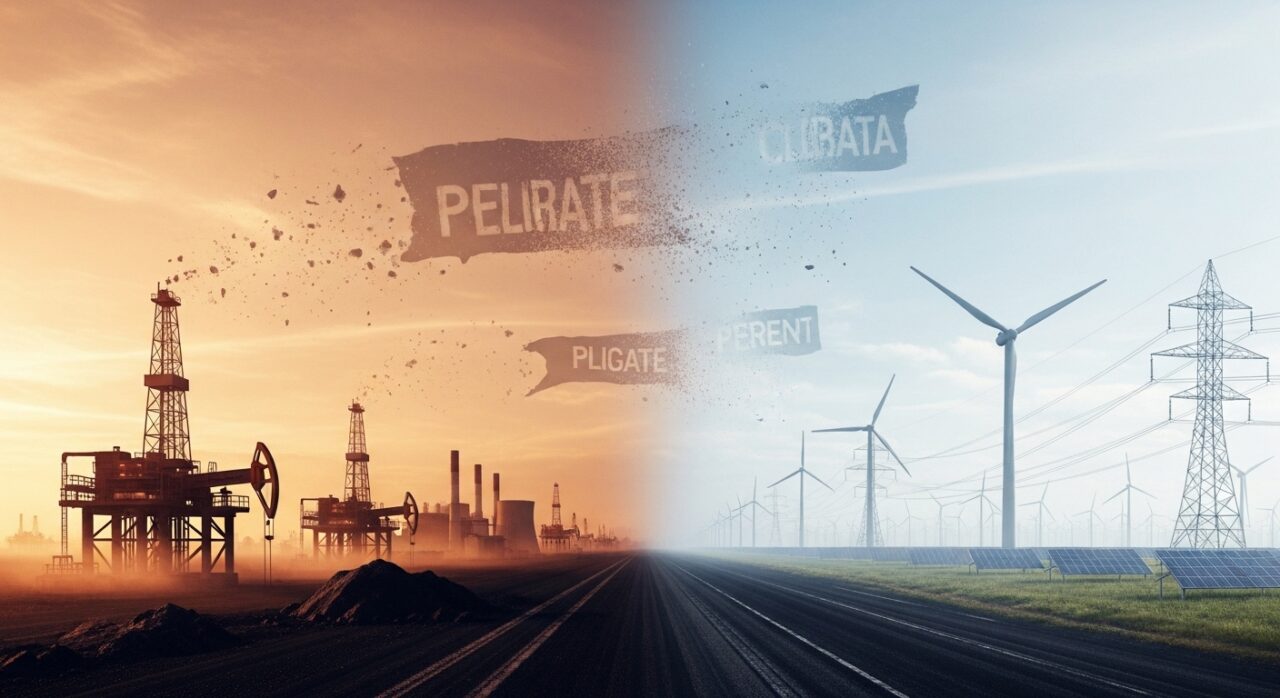
The International Energy Agency (IEA) has long been the official oracle of the ”green transition”. Its World Energy Outlook reports have provided politicians and investors with a mathematical explanation for why fossil fuels are ’just about’ to be phased out.
This year the tone changed. The World Energy Outlook 2025 brought back a scenario that the IEA itself had buried a few years ago: the Current Policies Scenario (CPS) – a world in which new climate action is no longer implemented in practice. In this version of reality, demand for oil and gas does not peak in the 2020s, but continues to grow at least until 2050.
The IEA’s own director Fatih Birol says bluntly that the political importance of climate policy is fading fast as governments grapple with security and cost of living crises. It’s a diplomatic way of saying: government talk and promises no longer match practical energy policy.
This is an #Analysis of what the new report really says – and why it is a far more important signal politically, economically and geopolitically than any COP summit keynote speech.
What does the IEA’s ”Current Policies Scenario” really say?
WEO 2025 has a familiar range of scenarios, but attention has been focused on one: the Current Policies Scenario (CPS). It does not assume new climate action, but a freeze – governments do not implement the planned additional cuts, but continue with existing laws and decisions.
In this world, the IEA sees the following:
- Oil demand will rise to 113 million barrels per day by 2050, especially in emerging economies (road transport, petrochemicals, aviation).
- Demand for natural gas will continue to grow throughout the mid-century as LNG capacity expands and prices remain competitive.
- Coal will decline before 2030, but will remain an important energy source for the next decade.
- Electricity grids will need to be extended by 25 million km by 2035 and a further 40 million km by 2050 to connect increased demand and decentralised generation to the system.
- EVs will only become more widespread where there is real policy support (Europe, China); elsewhere, the EV boom will stall.
From a climate perspective, the CPS makes cold reading:
The IEA estimates that the world will warm by about 2.9°C by 2100 on this trajectory – and continue to rise beyond.
At the same time, of course, the IEA points out that renewables are growing rapidly and will become the largest single source of energy in many regions before 2050. But the crucial point is another: fossil consumption is not collapsing, it is just growing a little more slowly – and for much longer – than the green rhetoric has promised.
Why was the CPS dug back up – and why now?
The IEA had previously advocated a model that fossil demand would peak already during this decade. Now it is backing away from its own optimistic story, and the timing is no coincidence.
The United States – the IEA’s largest donor – has openly criticised the organisation for being too ”green” in its scenarios and underestimating the long-term role of fossil fuels. The new administration in Washington made it clear that if the IEA wants continued US money, it must update its models to bring them closer to political reality.
There is also a broader narrative shift:
- The energy crisis, inflation and security concerns have pushed the ”climate emergency” to the back of governments’ priorities.
- Meanwhile, Bill Gates – one of the most prominent financiers of climate policy – released a statement at the end of October saying that climate change ”will not destroy humanity” and that the focus should shift back to poverty and disease.
As both governments and major philanthropists begin to publicly shift the focus away from the ”net-zero 2050” mantra, the IEA can no longer credibly argue that current policy is heading in the same direction.
The CPS is an honest – and politically embarrassing – mirror of this situation.
Targets vs. reality: NDC plans on paper
The UN Paris Agreement is built around NDC (Nationally Determined Contributions) plans – every five years, each country announces how it will cut its emissions.
In practice:
- Only some countries have submitted updated NDCs, and analyses show that current pledges take the world in the direction of around 2.5-2.8°C, not 1.5°C.
- More fundamentally, most countries are not even delivering on their promises – and this implementation gap is the reason why the CPS was brought back into the toolbox in the first place.
The IEA’s message is clear between the lines:
policy is not moving towards a Net Zero Scenario (NZE), but closer to the Current Policies/Stated Policies pathway, where emissions growth slows but does not reverse sharply.
In other words: the COP tables may talk about 1.5 degrees, but the energy system number tells a different story.
What does the energy realm really look like?
CPS draws a map showing:
- India, Indonesia and other emerging economies are the main drivers of electricity demand growth.
- Renewables are growing and getting cheaper, but grid capacity, storage and balancing power are bottlenecks: solar and wind will not replace fossil fuels together, but will come alongside them.
- Nuclear power will make a ”renaissance” in the 2030s, when some countries will tire of volatility and need stable base power.
- The role of natural gas will be prolonged as new LNG projects bring large quantities of relatively cheap gas to the market for years to come.
This is not a ”triumphal march” for fossil fuels, but a chilling illustration that the energy transition is not taking place on the terms of political declarations, but in the real world of networks, investment and demand.
EU and Finland: while the rest of the world backs down, Brussels steps on the gas
The new IEA scenario puts the EU in a strange light.
- The EU, and the UK in particular, have been good ”model students”, setting the most ambitious NDCs and committing to the fastest emission cuts.
- At the same time, the IEA’s CPS suggests that most of the world is no longer in the same game, prioritising affordable energy and growth over emissions policy.
This creates a classic trap for the EU:
- Industry pays the high energy price for emissions policies.
- Competitors (US, China, India, developing countries) get longer fossil life and cheaper energy.
- Emissions flexibility moves from point A to point B in the global market – the climate doesn’t win, but European industry and jobs lose.
From Finland’s perspective, WEO 2025 confirms one uncomfortable conclusion:
a silent majority of the world has chosen energy realism, even if public rhetoric continues to be green. The EU, on the other hand, has committed itself at the legislative level to targets from which it is politically difficult to retreat, even if the rest of the world is already retreating.
The narrative is changing – and it is no longer in the hands of the IPCC.
Interestingly, at the same time as the IEA acknowledges the fading of climate commitments, many of the key voices in the climate debate are also changing their tune:
- Bill Gates calls on the UN to ”pivot” away from climate focus and focus on vaccines and poverty.
- Major energy companies, such as TotalEnergies, are now backing scenarios where oil and gas use continues at least into the 2040s and 2050s – calling it ”realism”, not climate fraud.
This does not eliminate climate change as a physical phenomenon, but it does change the policy framework:
There is less and less talk about ”the end of the world after 1.5°C” and more and more about how to adapt climate alongside other priorities – security, poverty, energy access.
The IEA’s CPS is more than a technical scenario in this figure. It is a formal recognition that the net zero scenario no longer reflects the reality of policy.
What should you follow next?
If you want to see where energy policy is really heading, you should look less at posters and more at footnotes:
- COP30 final document: is there more talk of ”phase out” of fossil fuels, or a move to the soft language of ”transition fuels” – especially for natural gas?
- New NDC updates: how many countries are actually tightening their policy, and how many are quietly moving forward their target years?
- National backstops – such as cuts in subsidies for renewables, nuclear turnarounds or the phasing out of EV subsidies – often say more than new ”roadmaps”.
- Investment flows: will the promises of billions translate into oil, gas and LNG projects or truly large-scale renewable and grid investments?
Summary: The IEA says quietly what politicians have not dared to say
The message of the World Energy Outlook 2025 is ultimately simple:
- The climate burden no longer drives global energy policy, but is one priority among others.
- With current practices, demand for fossil fuels is not falling, but will rise for decades to come.
- According to the IEA, the 1.5°C target has also slipped – not because of a lack of technology, but because governments are not prepared to pay the political price to achieve it.
When the official energy watchdog starts to draw a scenario where climate action stops here and fossil fuels continue, it is effectively an announcement of the beginning of a new era:
The green utopia has hit a wall, and in its place comes a much uglier but more honest map of energy realism.
📚 So urces
- IEA – World Energy Outlook 2025: Energy Energy Energy: Overview and key findings
- IEA – World Energy Outlook 2025: Current state of policy
- Reuters – IEA says oil and gas demand could grow until 2050
- Financial Times – According to the IEA, demand for oil and gas will grow for 25 years without a global rate change.
- Skeptical Science – Examining recently published estimates of warming in current policy
- UNFCCC / WRI – NDC synthesis and ambition analysis.
- Channel News Asia – IEA’s Fatih Birol says climate action is losing ’political relevance’
- Australian Financial Review – The IEA predicts that gas demand will grow for 25 years even if the climate battle fails.
- Gates Notes / Bill Gates – Three hard truths about climate
- The Guardian – Bill Gates says the climate crisis will not ”destroy humanity”.